When bike gears won’t shift, the temptation is to turn every screw on the rear derailleur until something improves. Resist that urge. Most shifting faults are easier to diagnose if you begin with observation, cable movement, and wheel seating rather than random adjustment.
Assumes working pedals, wheels, cranks, and a familiar derailleur system. Covers common mechanical cable faults and basic electronic-shifting checks – not a full derailleur rebuild.
Start with the symptom and the easy checks
First, identify exactly what the bike is doing. “It won’t shift” can mean several different faults:
- The lever moves but the derailleur does not.
- The bike shifts in one direction but not the other.
- The chain hesitates between sprockets or changes gear by itself.
- The chain skips under pressure.
- The derailleur moves, but the chain will not reach the largest or smallest rear sprocket.
Put the bike in a repair stand, or lift the rear wheel safely so you can turn the cranks by hand. Do not diagnose a questionable gear change by sprinting up a hill. The hill will not provide useful technical feedback, although it may provide a memorable vocabulary lesson.
Check that the rear wheel is fully seated in the frame and that the quick release or thru-axle is tight. Confirm that the chain is present and that the derailleur has not been struck. Look closely at the gear cable and housing for a loose cable end, a kink, crushed housing, contamination, or housing that has pulled out of its frame stops.
Operate the shifter while watching the rear derailleur. This tells you whether the problem is mainly cable movement or derailleur alignment. A five-minute inspection often prevents a simple fault becoming an indexing mystery.
| Symptom | First checks |
|---|---|
| No derailleur movement | Check cable attachment, a broken inner cable, housing seating, and shifter operation. |
| Slow shift to larger sprockets | Inspect cable tension, housing friction, and hanger alignment. |
| Slow shift to smaller sprockets | Check excessive cable tension, dirty housing, and the derailleur return spring. |
| Skipping or ghost shifts | Check indexing, chain wear, cassette condition, stiff links, and cable movement. |
| Will not reach an end sprocket | Check the appropriate limit screw, cable release, hanger alignment, and obstructions. |
Follow the diagnosis: cable, indexing, hanger, then limits
Work through the likely causes in that order. Change one thing at a time and note the starting position before adjusting anything. That way, you can undo a change instead of trying to remember which of three guesses made the problem worse.
1. Check cable movement
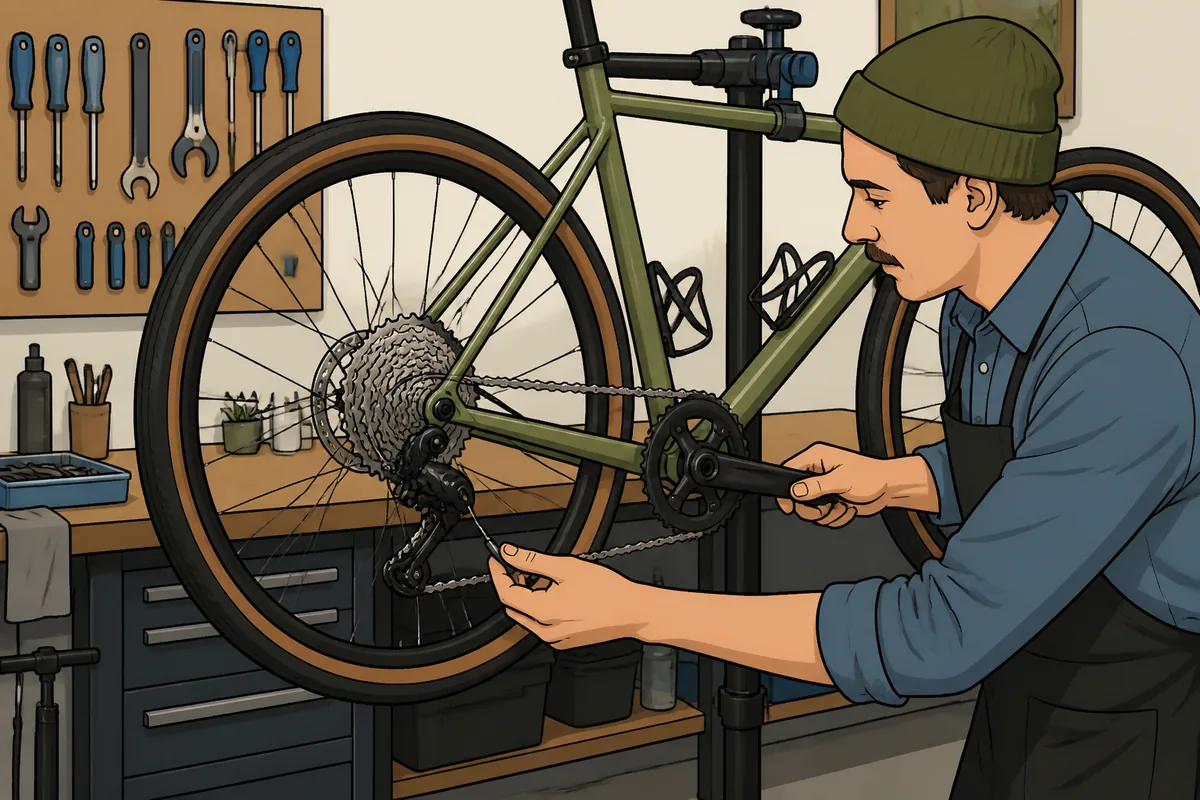
On a mechanical system, shift the lever while watching the cable and derailleur. If the lever moves but the derailleur barely responds, suspect a disconnected or broken inner cable, poor cable tension, contaminated housing, or housing that is not seated correctly.
The cable should move smoothly and the derailleur should respond immediately. If it moves in jerks, sticks, or returns slowly, the cable and housing may need replacement. A barrel adjuster cannot repair a frayed cable or crushed housing; it only changes cable tension.
On an electronic system, do not apply cable-tension advice. Check the battery charge, derailleur power, pairing, and any error indicator specified by the system manufacturer. If the derailleur has power but does not respond correctly, further diagnosis may require the manufacturer’s procedure or a compatible service tool.
2. Check indexing
If the derailleur moves normally but the chain sits between sprockets, the indexing is probably out of alignment. Indexing coordinates each click of the shifter with one sprocket on the cassette.
The barrel adjuster changes cable tension in small amounts. On most rear derailleurs, turning it to increase tension moves the derailleur toward the larger sprockets; turning it the other way reduces tension and favors the smaller sprockets. Make a small adjustment, turn the cranks, and check the shift again. A quarter turn is plenty for a first move.
A small indexing correction is the safest home fix when the derailleur moves normally and the wheel is secure. If the adjustment improves one part of the cassette but makes another part worse, stop adding tension and suspect hanger alignment or a cable problem.
3. Consider the derailleur hanger
The derailleur hanger connects the rear derailleur to the frame. If it is bent, the derailleur no longer sits in the same plane as the cassette. The result is often inconsistent shifting: one end of the cassette may work acceptably while the other refuses to cooperate.
A recent fall, transport mishap, or derailleur impact makes a bent hanger more likely. Do not try to straighten it by eye or repeatedly compensate with the barrel adjuster. Hanger alignment needs the correct gauge, and some manufacturers specify replacement rather than straightening for particular hanger designs. Our guide on how to adjust a rear derailleur covers normal setup, but it cannot make a bent hanger straight.
4. Check the limit screws last
The high- and low-limit screws restrict how far the derailleur can travel. They control the ends of the cassette, not ordinary slow or noisy shifting across the middle sprockets.
The low-limit setting controls travel toward the largest sprocket. If it is wrong, the chain may fail to reach the largest cog or may overshoot toward the spokes. The high-limit setting controls travel toward the smallest sprocket. If it is wrong, the chain may not reach the smallest cog or may sit noisily beside it.
Because an incorrect limit setting can send the chain into the spokes, do not force the shifter. If the derailleur approaches the wheel, stop and have the setup checked.
Practical fixes for common shifting faults
Slow or reluctant shifts to larger sprockets: check that the cable housing is seated and free of sharp bends. If the derailleur moves but the chain does not climb cleanly, add a small amount of cable tension with the barrel adjuster. Insufficient tension or cable friction can prevent the derailleur moving far enough.
Hesitation shifting to smaller sprockets: check for excessive cable tension, dirty or kinked housing, and a sticky derailleur spring. Reduce tension in small increments. Do not wind the barrel adjuster completely in or out as a first move, because you lose useful adjustment range.
Skipping or ghost shifting: distinguish a shifting fault from a worn drivetrain. Check that the cable movement is smooth, the chain is not damaged or stiff at a link, and the chain and cassette are not excessively worn. A chain that skips under load can point to wear, but poor indexing or a damaged sprocket can produce a similar symptom.
Use a chain-wear checker before buying a cassette. A Park Tool CC-4 is one example of a dedicated checker, but the important point is measuring before replacing parts. Chain wear measurement does not prove every shifting fault, and fitting a new chain can reveal that an old cassette is already worn. See our bike chain guide for related chain-buying and maintenance information.
Failure to reach the largest rear sprocket: check cable tension, housing friction, hanger alignment, and the low-limit screw. Also consider whether the derailleur has enough capacity for the cassette. Never force the lever if the derailleur could move toward the spokes.
Failure to reach the smallest rear sprocket: check whether the cable is releasing fully, whether the housing is dragging, and whether the high-limit screw is restricting travel. Look for an obstruction or derailleur impact before making repeated adjustments.
A basic work stand or safe repair position, 4 mm and 5 mm hex keys, a screwdriver, and a chain-wear checker cover many initial checks. Cable cutters are useful for cable replacement, but they are not a substitute for knowing how the cable should be routed. A derailleur hanger alignment gauge is a specialist tool; if you do not have one, this is usually a sensible workshop job.
When the problem is worn or damaged parts
Adjustment cannot repair a stretched or damaged cable, crushed housing, bent hanger, worn chain, hooked cassette teeth, damaged derailleur, or failing shifter. It is possible to make a worn system shift acceptably for a short time, but repeated fine-tuning is false economy.
Inspect the derailleur for impact damage, the rear wheel for poor seating or damage, and the cassette for looseness or play. A derailleur that contacts the wheel is not an indexing problem to test on the road.
Do not replace the cassette, derailleur, or shifter before checking the simpler causes. At the same time, do not keep adjusting around a known bent hanger or worn drivetrain. Confirm the fault first, then replace only the parts that have earned the expense. Check bike chain wear before blaming the cassette alone. If the chain is also leaving the chainrings or cassette, that is a separate problem from ordinary indexing – see why your bike chain keeps falling off.
Know when to stop and call a mechanic
Workshop help is the sensible choice for a bent hanger, damaged frame or derailleur, electronic-system faults, internal cable routing that needs specialist access, stripped adjusters, or shifting that remains poor after the basic checks.
Stop riding immediately if the chain can enter the spokes, the rear derailleur touches the wheel, the wheel is loose, or the chain drops into a dangerous position under load. The safest starting point is not another quarter-turn of an adjuster; it is preventing a minor shifting fault from becoming a wheel or frame repair.
Tell the mechanic which gears fail, whether the problem occurs under load, whether the bike was recently transported or hit, whether the chain was recently replaced, and which adjustments you made. That information is more useful than “it makes a weird noise,” even if that description is technically accurate.
The practical order is simple: observe the symptom, inspect cable movement, make one small indexing adjustment if appropriate, check hanger alignment and limits, then investigate wear or book service. That sequence solves the easy faults without disguising the expensive ones.
FAQs
Why won’t my bike shift into the biggest rear cog?
Check cable tension, housing friction, derailleur-hanger alignment, and the low-limit screw. Do not force the lever, especially if the derailleur could move toward the spokes.
Should I adjust the barrel adjuster when my bike gears stop shifting?
Only if the derailleur moves and the chain is misaligned between sprockets. Turn it in small increments and avoid using it to compensate for a bent hanger or damaged cable.
Can a worn chain cause gears to skip?
Yes, but skipping can also come from a worn cassette, damaged chain, poor indexing, or a stiff link. Check chain wear before replacing multiple drivetrain parts.

I’ve spent way more time in the bike trade than anyone should reasonably want to. In that time I’ve wanted to make cycling jargon and marketing easier to cut through to help people get the bike of their dreams.
When I’m not writing about bikes, I can be seen out bikepacking on single speed bikes or teaching kids how to ride.