Bike wheel sizes are one of those things that seem simple until you actually try to make sense of them.
26”, 27.5”, 29”, 700c, 650b… it quickly turns into a mix of numbers that do not look like they belong together.
The confusing part is that wheel size is not just about diameter. It affects how your bike feels, how it handles, how fast it rolls, and even how comfortable your ride is.
Once you understand what those numbers actually mean, choosing the right size becomes a lot easier.
What do bike wheel sizes actually mean?
Most wheel sizes refer to the approximate outer diameter of the wheel, including the tire.
The problem is that different standards have been used over time, which is why some sizes use inches (like 29”) and others use metric labels (like 700c).
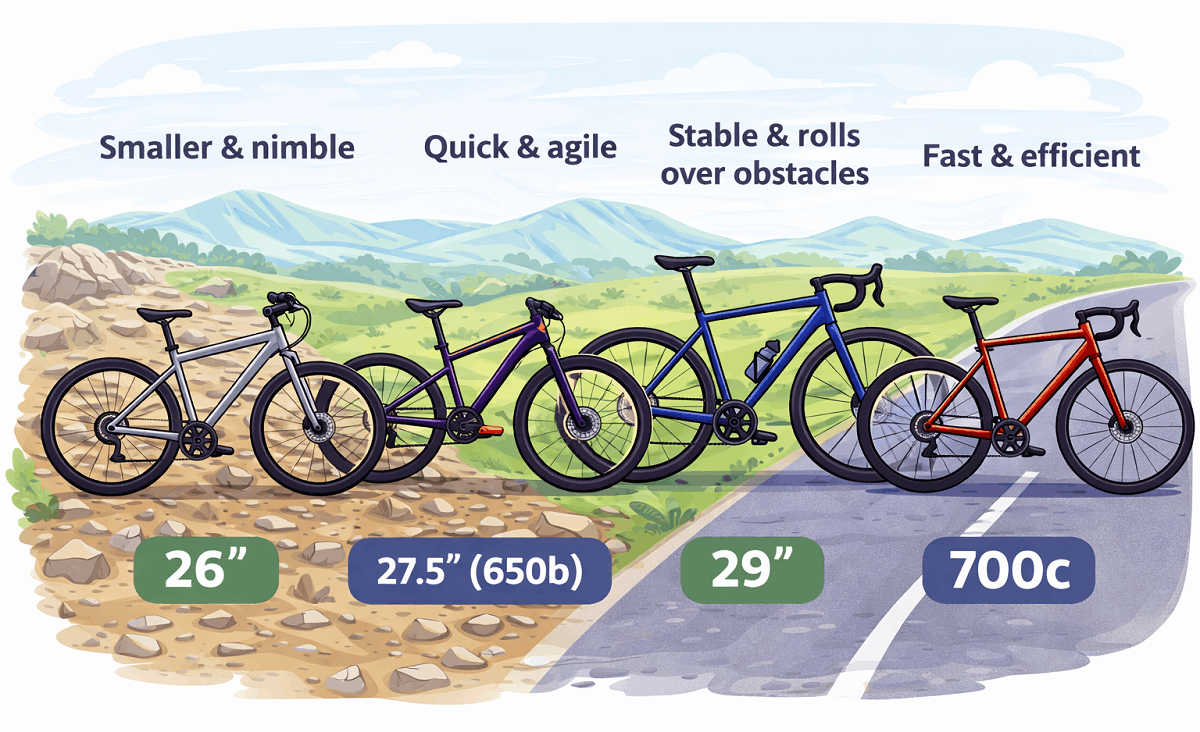
In simple terms:
- 700c = standard road bike size
- 29” = essentially the same diameter as 700c, but used on mountain bikes
- 27.5” (650b) = slightly smaller, more agile option
- 26” = older MTB standard, still common on budget or smaller bikes
What matters more than the label is how that size behaves when you ride.
700c wheels (road bikes and most gravel bikes)
This is the most common wheel size you will come across.
Road bikes, endurance bikes, and many gravel bikes use 700c wheels.
What they feel like on the road:
- Roll fast and hold speed well
- Feel smooth over long distances
- Carry momentum efficiently
You notice this most when riding at a steady pace. Once you are up to speed, 700c wheels make it easier to keep going without constantly pushing.
The trade-off is that they are slightly less agile in tight situations compared to smaller wheels.
If most of your riding is on the road, this is usually the best place to start.
29” wheels (modern mountain bikes)
29” wheels have become the standard for most mountain bikes.
They are essentially the same diameter as 700c but paired with much wider tires.
What they feel like on the trail:
- Roll over obstacles more easily
- Feel stable at speed
- Carry momentum through rough sections
When you hit roots, rocks, or uneven terrain, 29ers tend to smooth things out rather than getting hung up.
The downside is that they can feel a bit slower to accelerate and less nimble on very tight trails.
If you ride fast trails or rough terrain, 29” wheels make life easier.
27.5” (650b) wheels
27.5” wheels sit between 26” and 29”.
You will find them on mountain bikes and some gravel bikes (often labeled as 650b in that case).
What they feel like:
- More responsive and easier to turn
- Quicker acceleration
- Slightly less stable than 29”
This is the size that tends to feel more playful.
If you like tight corners, technical trails, or a more lively bike, 27.5” wheels often feel more natural.
On gravel bikes, 650b setups are often used with wider tires to add comfort and grip.
26” wheels (older but not gone)
26” used to be the standard for mountain bikes.
While it has largely been replaced by 27.5” and 29”, it still appears on:
- Older bikes
- Budget models
- Smaller frame sizes
What they feel like:
- Very quick to accelerate
- Easy to handle at low speeds
- Less stable over rough terrain
They can still be perfectly usable, but compared to modern wheel sizes, they feel less capable when the terrain gets rough.
650b vs 700c on gravel bikes
This is one of the more interesting choices, because both sizes are used on the same type of bike.
700c setup:
- Faster on smoother surfaces
- Better for long-distance efficiency
650b setup:
- Wider tires for more comfort
- Better grip on rough terrain
You can think of it like this:
700c is better when your ride stays predictable.
650b works better when the surface starts to break down.
If you are unsure, it is worth reading our comparison on gravel vs mountain bikes to see how terrain affects your setup.
How wheel size affects your ride
Wheel size is not just a number. It directly changes how your bike behaves.
Speed
Larger wheels (700c / 29”) hold speed better once you are moving.
Acceleration
Smaller wheels (26” / 27.5”) feel quicker off the line.
Comfort
Larger wheels combined with wider tires absorb more bumps.
Handling
Smaller wheels feel more agile, larger wheels feel more stable.
This is why there is no single “best” wheel size. It depends on what kind of riding you do.
Which wheel size should you choose?
If you want a simple way to decide:
- Mainly road riding: 700c
- Gravel and mixed terrain: 700c or 650b depending on roughness
- Mountain biking (general use): 29”
- Mountain biking (technical trails): 27.5”
- Older or budget bikes: 26”
If you are buying a new bike, the wheel size is usually chosen for you based on the type of bike.
The real decision comes when you have options, especially with gravel bikes.
Does wheel size matter that much?
Yes, but not always in the way people think.
The difference is not just speed or comfort. It is how confident the bike feels underneath you.
A 29” mountain bike can make rough trails feel manageable.
A 700c road bike can make long distances feel easier.
A 650b gravel setup can turn a harsh ride into something much more forgiving.
It is less about chasing the “best” size and more about choosing the one that matches where you actually ride.
Our verdict
Wheel size is one of the biggest factors in how a bike feels, but it only makes sense when you look at it in context.
If you stay on the road, 700c is hard to beat.
If you ride trails, 29” will make things easier.
If your rides are mixed or unpredictable, 650b is worth considering.
The best choice is usually the one that fits your riding, not the one that looks best on paper.

I’ve spent way more time in the bike trade than anyone should reasonably want to. In that time I’ve wanted to make cycling jargon and marketing easier to cut through to help people get the bike of their dreams.
When I’m not writing about bikes, I can be seen out bikepacking on single speed bikes or teaching kids how to ride.