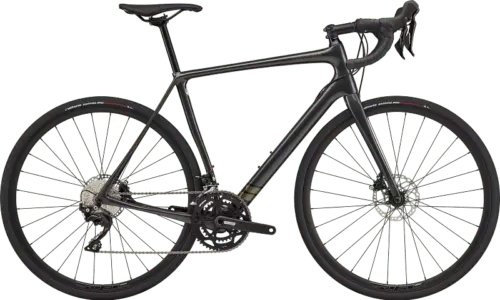
A lot of riders end up choosing between a hybrid and a gravel bike for the same reason.
You want one bike that can do a bit of everything.
Commute during the week, ride a bit further on weekends, maybe take the odd detour onto a gravel path without worrying too much about it.
On paper, both bikes seem to offer that.
In reality, they approach it in completely different ways, and that changes how they feel the moment you start riding.
The easiest way to think about it is this.
A hybrid bike makes riding easier.
A gravel bike makes riding faster and more capable.
Where they feel similar (at first)
If you test ride both on a short loop, especially on smooth roads, they might not feel that far apart.
Both are comfortable. Both are stable. Neither feels aggressive or difficult to ride.
This is why the choice can feel confusing early on.
The differences only really show up once you ride a bit further or the surface starts to change.
What a hybrid bike is really built for
Hybrid bikes are designed to be simple and predictable.
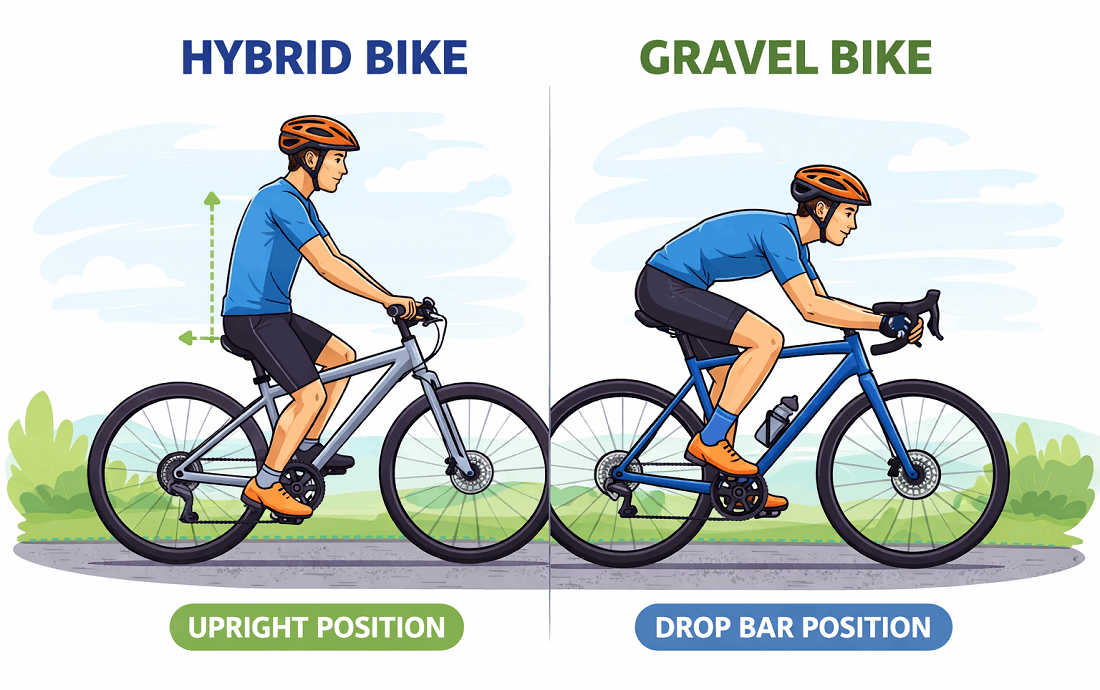
- Flat handlebars
- Upright riding position
- Moderate tire width
- Low-maintenance components
You get on, start pedaling, and everything just feels natural.
That is exactly the point.
Hybrid bikes are very good at short rides, commuting, and situations where you are stopping and starting often.
They are also forgiving if your bike fit is not perfect.
You sit upright, you can see everything around you, and there is very little learning curve.
What a gravel bike is really built for
Gravel bikes are built with distance and efficiency in mind.
- Drop handlebars
- More stretched riding position
- Wider tire clearance
- More performance-focused geometry
They still aim to be comfortable, but it is a different kind of comfort.
Instead of sitting upright, you are slightly more forward, which helps you ride longer without fighting the wind.
It might feel less natural at first, but over time it starts to make more sense, especially on longer rides.
Handlebars and how they change the ride
This is one of the biggest real-world differences.
Hybrid bikes use flat bars, which are simple and intuitive.
You always have the same hand position, and control feels very direct. That is especially useful in traffic or on short rides.
Gravel bikes use drop bars, which give you multiple hand positions.
This becomes important on longer rides.
You can move your hands, change your posture slightly, and avoid putting pressure on the same points for hours.
At first, drop bars can feel unfamiliar. After a few longer rides, they usually feel more natural than flat bars.
What you notice when you pick up speed
This is where the gap starts to open up.
Hybrid bikes feel fine at lower speeds, but once you start pushing a bit harder, they begin to feel inefficient.
The upright position catches more wind, and the gearing is not always designed for sustained speed.
Gravel bikes, on the other hand, feel like they want to keep going.
The riding position, gearing, and overall setup make it easier to hold speed with less effort.
On short rides, this does not matter much.
On longer rides, it becomes very noticeable.
What happens when the road gets rough
Both bikes can handle imperfect surfaces, but they do it differently.
Hybrid bikes are comfortable on light gravel paths and rough roads, but once things get looser or more uneven, they start to feel a bit out of their depth.
Gravel bikes are built for exactly that situation.
Wider tires, more stable geometry, and better control mean you can keep riding at a steady pace instead of constantly backing off.
This is where gravel bikes really start to make sense.
Tires and grip
Hybrid bikes usually run tires around 35–45mm.
That is enough for comfort and light off-road use.
Gravel bikes can go wider, often 40–50mm or more.
The extra width gives you more grip, more comfort, and more confidence on loose surfaces.
It also allows you to run lower pressures, which smooths out rough terrain.
If your rides include anything more than the occasional gravel path, this becomes important quickly.
Gearing and how it feels over distance
Hybrid bikes tend to use simpler gearing, often borrowed from mountain bikes.
It works well for casual riding and climbing, but it is not always ideal for maintaining speed.
Gravel bikes use more road-oriented gearing or gravel-specific setups.
This gives you better control over cadence, especially on longer rides.
It is one of those things you do not notice immediately, but after an hour or two, it starts to matter.
If you want a deeper look at gearing, it is worth reading how many gears you really need.
Comfort is not the same thing
Hybrid bikes feel comfortable straight away.
You sit upright, there is less pressure on your hands, and everything feels relaxed.
Gravel bikes feel more efficient over time.
The riding position, combined with multiple hand positions, reduces fatigue on longer rides.
On a 20-minute ride, a hybrid might feel better.
On a 2-hour ride, a gravel bike often does.
Versatility in real use
Gravel bikes are more versatile, but not in the way people often think.
They are not better because they can technically do more. They are better because they let you keep riding when conditions change.
You do not have to turn back when the road turns to gravel.
You do not have to slow down as much when surfaces get rough.
Hybrid bikes are versatile within a narrower range.
They are excellent for commuting, errands, and casual riding, but they are not designed for longer or more demanding routes.
Where each bike starts to struggle
This is often the deciding factor.
Hybrid bikes start to feel limiting when:
- rides get longer
- you try to maintain higher speeds
- terrain becomes rough or inconsistent
Gravel bikes start to feel less ideal when:
- you are riding short, stop-start city routes
- you want maximum comfort with minimal effort
- you do not need the extra capability
Who should choose a hybrid bike?
- New riders who want something easy to ride
- Commuters and casual cyclists
- Short-distance riders
- Anyone who values simplicity over performance
Hybrid bikes are very easy to live with.
Who should choose a gravel bike?
- Riders planning longer distances
- Those riding mixed terrain regularly
- Anyone who wants one bike for multiple types of riding
- Riders who value efficiency and capability
Gravel bikes make more sense the more you ride.
Useful gear and accessories
If you are still comparing options, it is also worth reading are road bikes faster than hybrids and gravel vs mountain bikes.
Our verdict
Hybrid bikes are easier, simpler, and better for everyday use.
Gravel bikes are faster, more capable, and better for longer and more varied rides.
If your riding is mostly short and practical, a hybrid is the better choice.
If your riding is growing or becoming more varied, a gravel bike will take you further.

I’ve spent way more time in the bike trade than anyone should reasonably want to. In that time I’ve wanted to make cycling jargon and marketing easier to cut through to help people get the bike of their dreams.
When I’m not writing about bikes, I can be seen out bikepacking on single speed bikes or teaching kids how to ride.