Going uphill is hard, but going downhill is where things can get interesting very quickly.
A climb will usually give you time to think. A descent does not. You can go from feeling comfortable to feeling in over your head in a matter of seconds.
That is why descending well is not about being brave. It is about being smooth, staying relaxed, and not asking too much from yourself or your bike.
If you are new to road cycling, descending can feel pretty intimidating. Even if you have been riding for years, there will still be roads and conditions that make you back off a bit. That is normal.
The good news is that descending is a skill. Like all cycling skills, it can be improved if you take your time and work on the basics.
If your brakes are not working as they should, it is worth first reading our guide on how to setup, adjust & maintain disc brakes on a bike. You should also have a look at how to fix squeaky brakes on a bike if your braking is noisy or inconsistent.
Why descending feels difficult
The simple reason descending feels difficult is speed.
You do not have to pedal very hard, or at all, to end up going fast on a road bike. Once the speed starts to build, everything happens more quickly. Corners arrive sooner, rough patches matter more, and small mistakes become bigger ones.
It also does not help that when you are nervous, your body usually does exactly the wrong thing.
You tense up, lock your arms, grip the bars too tightly, and stare at the bit of road you are most worried about hitting.
None of that helps.
The aim is not to fly downhill like a pro rider. The aim is to be in control all the way down.
Start with your position on the bike
One of the first things to get right is your body position.
You want to stay low enough to feel stable, but not so low that you become stiff and awkward. You also want to keep your weight balanced on the bike rather than throwing it too far back.
A lot of riders make the mistake of sitting bolt upright on descents because they feel safer that way. Usually it just makes the bike feel less planted.
Instead, try this:
Keep your elbows bent
Bent elbows help your bike move underneath you and stop every bump being fired straight into your upper body.
Relax your shoulders
If your shoulders are up by your ears, you are too tense.
Keep a light grip on the bars
You want control, not a death grip.
Lower your chest slightly
This helps with stability and stops you catching as much wind.
Keep your pedals level unless cornering
That gives you a neutral and stable position on straight sections.
The thing to remember is that your road bike wants to be stable. If you stay loose and let it move naturally, it will usually behave better than if you try and wrestle it all the way down.

Where to put your hands
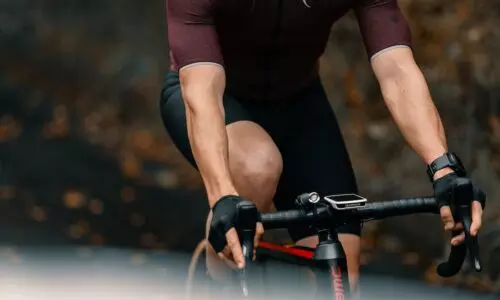
For most descents, the drops are the best place to be.
Riding in the drops lowers your center of gravity a little, gives you a firmer hold on the bars, and most importantly makes it easier to brake properly.
That last point matters a lot.
If you are on the hoods and the road suddenly tightens up, you may not have quite as much braking control as you want. In the drops, your hands are more secure and you can modulate the brakes better.
If you are not used to descending in the drops, practice it on an easy hill first rather than waiting until you are already going too fast.
Look where you want to go
This is one of those things that sounds simple, but it makes a huge difference.
Your bike will tend to go where your eyes go.
If you stare at a pothole, loose gravel, or the curb, there is a decent chance you will drift towards it. If you look through the corner and focus on the line you want to take, the bike will usually follow.
That means you should not be looking straight in front of your wheel all the time.
Lift your vision and scan ahead. Try to read the road before you get to the problem rather than reacting to it at the last second.
Look for:
- corners tightening up
- rough surfaces
- gravel near the edge of the road
- wet patches under trees
- traffic coming wide on bends
The earlier you spot these things, the smoother your descent will be.
How to brake properly on a descent
A lot of descending problems come from poor braking rather than lack of courage.
The biggest mistake is leaving your braking too late and then grabbing a handful of lever halfway into a corner.
That is how bikes start to feel sketchy.
Your braking wants to be done early, smoothly, and in a straight line wherever possible.
Try to get your speed down before the corner rather than during it. Once you are turning, you want the bike settled, not fighting against braking forces.
A few things help here:
Use both brakes
Your front brake does most of the work, but the rear helps keep things balanced.
Brake smoothly
Squeezing the levers progressively is much better than snatching at them.
Do not drag the brakes all the way down
Constant light braking can overheat things and also leaves you less relaxed. It is usually better to brake firmly when needed, then release.
Finish most of your braking before the turn
Your tires only have so much grip to work with. You do not want to waste too much of it while cornering.
If you are not confident in your braking, it is worth making sure your pads and rotors are in good shape. A decent set of gloves can also help you feel more secure on long descents, especially if your hands get sweaty.
The other thing worth mentioning is that panic braking usually comes from going into a descent too fast for your comfort level. There is no shame in scrubbing speed early. It is far better to enter a corner a bit too slow than a bit too fast.
Cornering on the way down
Once you start mixing speed with corners, you need to be smooth.
The basic rule is simple enough. Slow down before the corner, look through it, and let the bike roll round rather than forcing it.
As you turn, put your outside pedal down and keep more weight through it. That helps the bike feel more stable and reduces the chance of clipping your inside pedal on the road.
You also want your inside knee and upper body to stay relaxed. You are leaning the bike into the turn, not throwing your whole body across it like you are in a MotoGP race.
Most road descents reward calm inputs. Sudden steering, sudden braking, and sudden body movements are usually what cause problems.

Choosing the right line
You do not need to be racing to think about your line through a descent.
A good line just makes everything easier. It smooths out the corner and gives you more room to deal with anything unexpected.
The general idea is:
- start wider on entry
- move towards the apex (the inside of the corner)
- let the bike run wide again on the exit
That said, this only works if you stay within your lane.
On open roads, you should never be crossing the center line just to get a better angle. It might feel quicker, but it is not worth the risk of a car coming the other way.
On tighter descents, it is often better to sacrifice a bit of speed and keep things simple rather than trying to carry too much pace.
Watch the road surface
Not all roads are created equal.
A smooth, dry descent is one thing. A damp road covered in leaves or gravel is something else entirely.
Even if you are confident, you should always be reading the surface as you go down.
Things to watch for:
- loose gravel, especially near the edges
- wet patches under trees or in shaded areas
- oil or diesel on the road (often near junctions)
- potholes and broken tarmac
If you spot any of these, adjust early.
That usually means slowing down a bit and keeping your inputs even smoother than usual. Sudden braking or turning on a poor surface is where grip disappears quickly.
If your tires are worn or not suited to the road conditions, it is worth sorting that before chasing more speed downhill. We have also covered the best road bike tires if your current setup is due for an upgrade.
Common mistakes to avoid
Most descending issues come down to a few repeat mistakes.
Braking too late
Leaving everything until the last second usually leads to panic.
Braking in the middle of a corner
This unsettles the bike and reduces grip when you need it most.
Being too stiff
Locked arms and tight shoulders make the bike harder to control.
Looking down instead of ahead
This reduces your reaction time and makes your line worse.
Trying to go too fast too soon
Confidence should build gradually, not all at once.
If you find yourself doing any of the above, slow things down and reset. There is no rush.
Building confidence on descents
Confidence does not come from one fast ride. It comes from repeating the basics until they feel natural.
The easiest way to build it is to find a descent you know well and ride it a few times.
Start at a comfortable speed and focus on being smooth rather than fast. As things start to feel easier, you can let the speed build a little.
Over time, you will find that what used to feel quick now feels controlled.
It is also worth riding with someone who is slightly more experienced. Not to chase them, but to watch how they move on the bike and how early they brake.
Just make sure you still ride within your own limits.
Descending in wet conditions
Everything becomes a bit more delicate when the road is wet.
Your tires have less grip, braking distances increase, and small mistakes are less forgiving.
The adjustments are simple:
- slow down earlier than you think you need to
- brake more gently and progressively
- avoid sudden movements
- stay even more relaxed on the bike
You should also avoid painted road markings, metal drains, and manhole covers where possible. They can be surprisingly slippery in the wet.
Final thoughts
Descending is one of the most enjoyable parts of riding once you get comfortable with it.
You do not need to be the fastest rider on the way down. You just need to be in control.
If you focus on staying relaxed, braking early, and looking ahead, most of the hard work is already done.
The rest comes with time on the bike.

I’ve spent way more time in the bike trade than anyone should reasonably want to. In that time I’ve wanted to make cycling jargon and marketing easier to cut through to help people get the bike of their dreams.
When I’m not writing about bikes, I can be seen out bikepacking on single speed bikes or teaching kids how to ride.