Choosing the right road-bike frame size starts with two useful numbers: your height and your cycling inseam. This road bike size chart gives you a sensible starting range, but it is not a buying verdict. A 54 cm bike from one brand can put you in a noticeably different position from a 54 cm bike elsewhere.
Use the chart to narrow the field, then check the exact model’s geometry. Stack, reach, saddle position and the amount of adjustment available will tell you far more than a generic XS, medium or 54 cm label. This guide assumes you can already balance and pedal a bicycle; it covers choosing the frame, not learning to ride or completing a professional bike fit.
Road bike size chart by height and inseam
Measure your height and cycling inseam, find the closest overlapping range below, and treat the result as a shortlist. Road-bike frame sizes are usually expressed in centimeters, although some manufacturers use XS, S, M and L or their own numeric labels. Those labels are not standardized. One company’s medium may be another company’s 54 cm, at least on paper.
| Rider height | Height in feet/inches | Cycling inseam | Inseam in inches | Suggested frame size |
|---|---|---|---|---|
| 150-155 cm | 4’11"-5’1" | 70-74 cm | 27.6"-29.1" | 47-49 cm / XXS-XS |
| 153-158 cm | 5’0"-5’2" | 72-76 cm | 28.3"-29.9" | 48-50 cm / XS |
| 156-162 cm | 5’1"-5’4" | 74-78 cm | 29.1"-30.7" | 49-51 cm / XS-S |
| 160-166 cm | 5’3"-5’5" | 76-80 cm | 29.9"-31.5" | 50-52 cm / S |
| 164-170 cm | 5’5"-5’7" | 78-82 cm | 30.7"-32.3" | 51-53 cm / S-M |
| 168-174 cm | 5’6"-5’9" | 80-84 cm | 31.5"-33.1" | 52-54 cm / M |
| 172-178 cm | 5’8"-5’10" | 82-86 cm | 32.3"-33.9" | 53-55 cm / M |
| 176-182 cm | 5’9"-6’0" | 84-88 cm | 33.1"-34.6" | 54-56 cm / M-L |
| 180-186 cm | 5’11"-6’1" | 86-90 cm | 33.9"-35.4" | 56-58 cm / L |
| 184-190 cm | 6’0"-6’3" | 88-93 cm | 34.6"-36.6" | 57-59 cm / L-XL |
| 188-196 cm | 6’2"-6’5" | 91-97 cm | 35.8"-38.2" | 59-61 cm / XL-XXL |
These ranges deliberately overlap. They are broad starting points built around common road-bike sizing patterns, not promises that every rider in a height band will fit the same frame. The overlap matters because two riders at 170 cm may have very different leg, torso and arm proportions. A rider at the edge of a range should compare both candidate sizes rather than treating the table as a precise answer.
If your height and inseam point to different sizes, that is useful information rather than a mistake. It suggests that the bike’s stack, reach and adjustment range deserve closer attention. Crank length, shoes, cleats, saddle shape, seat-tube angle and riding position also affect the final setup.
Do not assume that the frame size is the length of the seat tube in any simple, universal sense. Modern frames may use sloping top tubes, interrupted seat tubes and different ways of measuring the tube. More importantly, the seat-tube number says little about how far forward the bars are or how high the front of the bike sits.
A 54 cm endurance bike may have a taller head tube and shorter reach than a 54 cm race bike. Both can be correctly labeled, but they will not feel identical. That is why the safest starting choice for most first-time and comfort-focused riders is the frame with a manageable reach and usable stack, not the bike carrying the most aggressive size label.
How to use the chart without choosing the wrong size
Start with two measurements: your height and your cycling inseam. Use them to identify a sensible range, then check the manufacturer’s chart for the exact model. The brand’s model-specific geometry always outranks a generic road bike size chart.
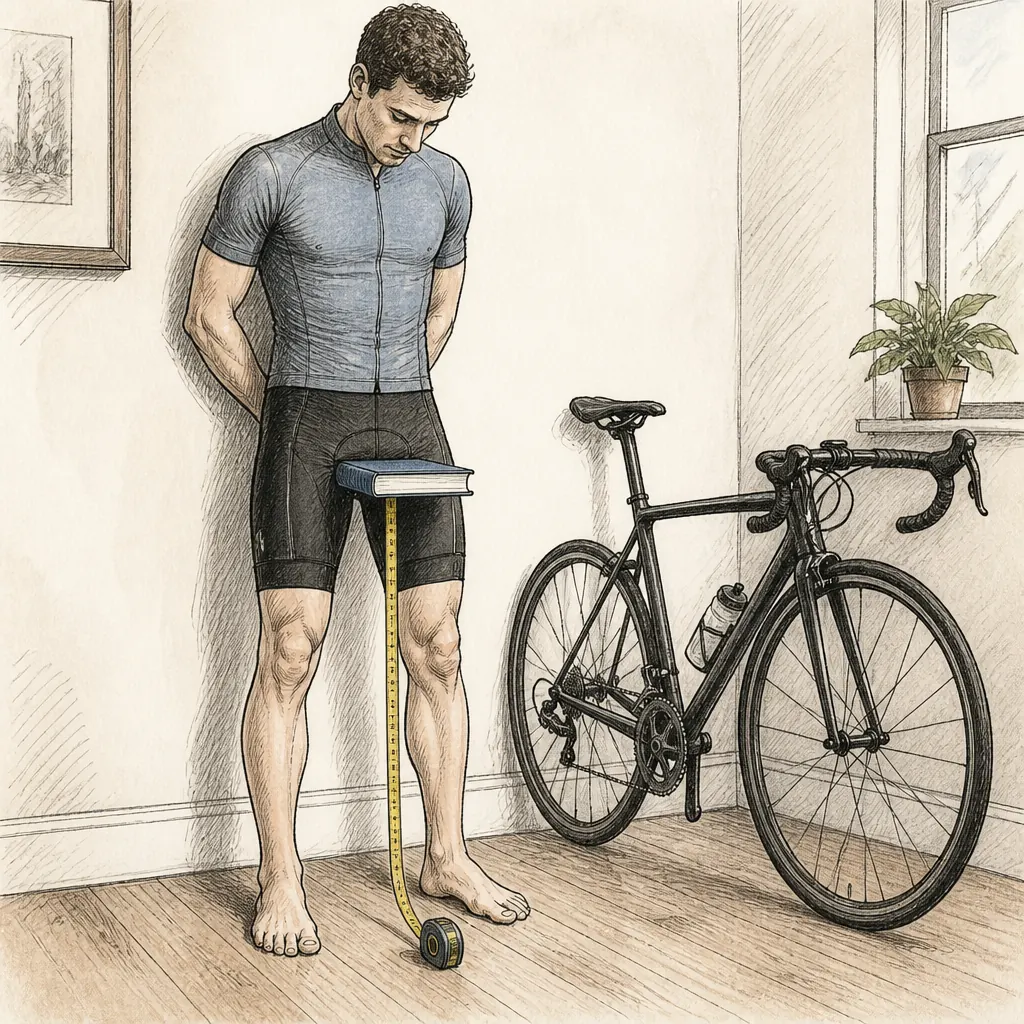
Measure your inseam barefoot. Stand against a wall with your feet roughly shoulder-width apart, place a firm book between your legs, and press it upward with the same pressure you would use on a saddle. Keep the book level, then measure from the floor to the top of it. If your measurement is borderline, repeat it rather than building a new bike around one optimistic centimetre.
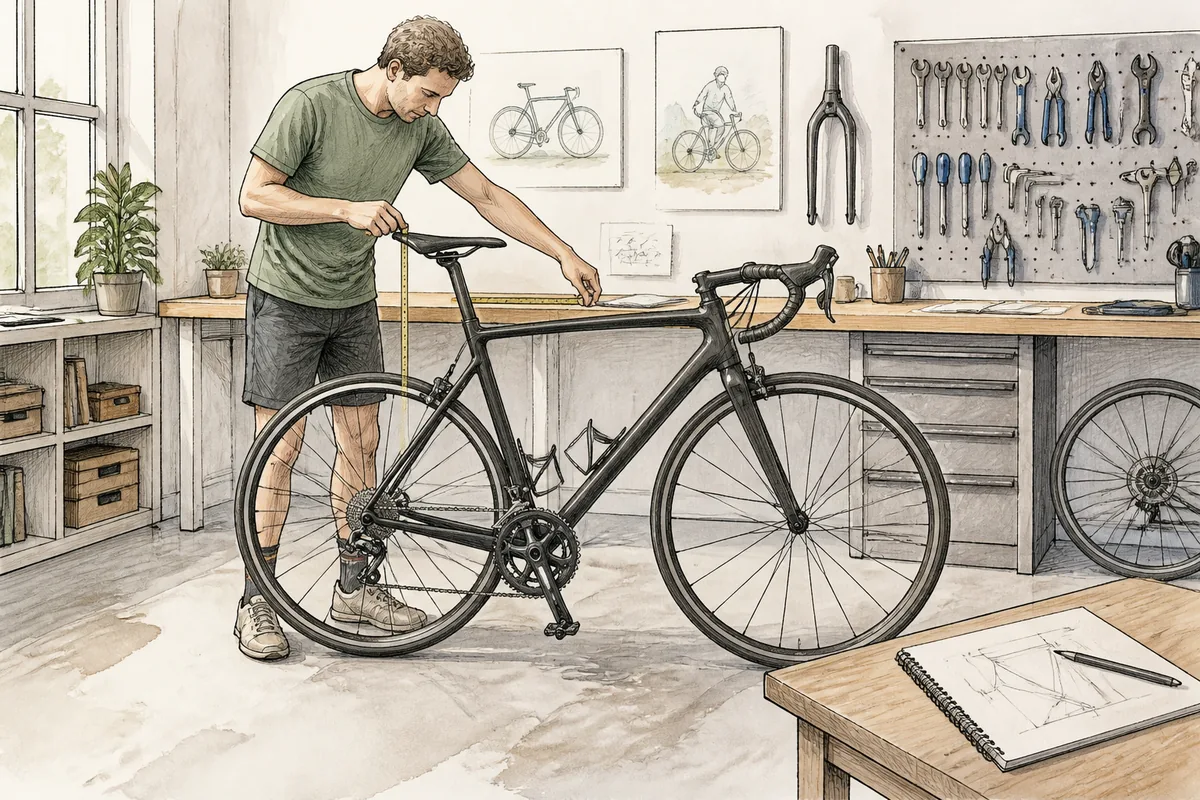
Our guide to how to measure your bike frame size covers the measurement process in more detail.
Height alone is a weak sizing tool because riders of the same height can have very different leg, torso and arm lengths. A longer-legged rider may need more saddle height but not necessarily a longer cockpit. A rider with a long torso may need more reach without wanting an especially tall frame.
Suppose the chart puts you between a 52 and 54 cm bike. Do not settle the question by looking at the label or checking only standover clearance. Compare the two bikes’ stack and reach, then consider saddle height, handlebar height, stem length and the riding position you actually intend to use. The better size is usually the one that gets close with ordinary adjustments.
Standover clearance is useful for rejecting an obviously unsuitable frame, but it is a poor primary fit test on a road bike. You do not pedal from a straddle position. Reach and front-end height affect every minute you spend riding.
If the manufacturer’s chart and your measurements disagree, pause before ordering. Compare the exact geometry and adjustment range, and use the brand’s return policy to protect yourself if buying online. A confident size calculator is still only a calculator; it cannot account for your proportions or the bike’s cockpit hardware.
Why road bike geometry matters more than the frame-size label
Frame size is only a shorthand. The useful numbers are stack and reach. Stack is the vertical distance from the bottom-bracket area to the top of the head tube. It gives you a good indication of how high or low the front end will sit. Reach is the horizontal distance to that same point, and it helps show how stretched you will be.
A bike with more stack generally gives you a taller, less demanding front end. More reach generally creates a longer cockpit. Neither number tells the entire story, but together they are far more useful than assuming every 54 cm bike has the same proportions.
Endurance road bikes usually have more stack and a less aggressive riding position than race bikes. That can make them a better starting point for long rides, commuting and riders who do not want to spend every mile folding themselves over the front wheel. Race geometry can be appropriate when you have the flexibility, conditioning and reason to use a lower position, but the race label does not make an undersized frame faster.
The effective top tube gives another clue about cockpit length, particularly when comparing frames with different seat-tube angles. A steeper seat-tube angle can move the saddle forward relative to the bottom bracket, changing how much room you have between saddle and bars. Head-tube angle and wheelbase matter more for steering feel and stability than direct fit, although a longer wheelbase often accompanies a calmer endurance-bike design.
| Geometry or adjustment | What it tells you |
|---|---|
| Stack | How tall or low the front end is likely to feel. More stack usually suits a more upright, sustainable position. |
| Reach | How long the frame is toward the handlebars. It is a key number when you are concerned about feeling stretched. |
| Effective top tube | A useful secondary comparison of cockpit length, especially when seat-tube angles differ. |
| Seat-tube angle | Influences saddle position and the effective distance to the bars. |
| Saddle-height range | Shows whether the frame can accommodate your leg length without excessive seatpost extension. |
| Stem length | Provides some reach adjustment, but a very long or very short stem is not a proper rescue plan for the wrong frame. |
| Spacer allowance | Shows how much front-end height can be changed. Integrated systems may offer less adjustment than conventional stems. |
| Handlebar reach | Changes how far you reach to the hoods and drops, even when the frame geometry is identical. |
For most first-time and comfort-focused riders, suitable stack and manageable reach should take priority over chasing a smaller, racier size label. A position you can hold comfortably is more useful than an aggressive one that looks impressive in a product photograph.
What to do when you are between road bike sizes
There is no universal rule that says you should always size down or always size up. Choose the frame whose stack and reach put you closest to your intended riding position, with the fewest extreme corrections.
A smaller frame can offer a shorter reach and lively handling. It may also require more saddle height, more seatpost exposure and a taller stack of spacers to achieve a comfortable bar position. That is not automatically bad, but the adjustment range needs checking.
A larger frame can provide more stack and a stable, roomy fit. The problem is excessive reach. A longer stem will not fix a frame that is already too long, and moving the saddle forward to reduce the distance to the bars can alter your position over the pedals. Judge the frame from its stack and reach first; use saddle and stem changes only for normal fine-tuning.
Normal adjustments include saddle height, saddle fore-aft within the safe rail limits, a modest stem-length change, spacers within the manufacturer’s limits and a handlebar with a different reach. These are fine-tuning tools, not magic wands.
Be suspicious of an extreme stem, a huge spacer stack, a saddle pushed to the end of its rails or a radically different seatpost being used to rescue a poor match. Those changes can affect handling, weight distribution or the amount of adjustment left for later. Integrated cockpits and proprietary seatposts make this especially important because replacement parts may be expensive or unavailable.
A qualified bike fitter or experienced retailer is particularly useful if your proportions are unusual, you have persistent discomfort, you are replacing a bike with a very different geometry, or you are buying an expensive bike with an integrated cockpit. Stop riding and seek qualified bike-fit or medical advice if pain or numbness persists; a new frame size is not a diagnosis.
Road bike sizing by rider type and bike style
For a first road bike, choose the most forgiving frame and position that give you a manageable reach and enough saddle adjustment. Beginners commonly overbuy the idea of a race fit. A low front end may look purposeful, but it is not a performance upgrade if you cannot comfortably use the hoods or stay relaxed for a full ride.
For endurance riding, commuting and long-distance use, prioritize usable stack, moderate reach and a position you can maintain without constantly supporting yourself on the handlebars. Tire clearance and mounting points matter for these uses too, but they do not compensate for a frame that is fundamentally too long.
For racing or aggressive training, a lower front end can make sense if your flexibility and conditioning support it. Compare the actual stack and reach rather than assuming the smallest available size will be the fastest. A race bike still needs to fit your body.
Gravel-capable road bikes can use different geometry and sizing conventions, including taller front ends and longer wheelbases. Do not transfer this road-bike chart blindly to a gravel model. Use the exact model’s chart and compare its geometry with the position you want.
Women and riders with shorter torsos or longer legs do not need to be forced into simplistic gendered sizing assumptions. Proportions and the bike’s geometry matter more than the label on the marketing page. The same applies to older, less flexible and comfort-focused riders: a taller, more relaxed option is a sensible starting point only if its reach remains manageable. Raising the bars cannot fully solve an overly long frame.
Common road bike sizing mistakes
- Choosing solely by height. Inseam, torso length and arm length can change which size deserves closer inspection.
- Assuming every 54 cm, medium or large bike fits the same. Nominal labels are not standardized enough to guarantee an equivalent position.
- Automatically buying the smaller frame. A short reach can be useful, but excessive spacers or a tall stem may reveal that the frame is not the right match.
- Buying a larger frame for standover clearance. Extra clearance does not make an excessive reach disappear.
- Copying the size of your previous bike. Compare stack, reach, saddle position, handlebar dimensions and intended tire size first.
- Treating saddle height as proof of fit. Correct saddle height does not guarantee a suitable cockpit.
- Assuming a professional fit can make any size work. A fit refines a suitable starting point; it cannot repeal frame geometry.
- Ignoring shoes and cleats. Your position can change when the new bike is compared using different footwear, pedals or cleat placement.
A practical checklist before you buy
- Record your height and cycling inseam. Torso and arm measurements are useful when you are between sizes.
- Save the exact model-year geometry chart, not just the brand’s general XS-to-XL guide.
- Compare stack, reach, seat-tube angle, head-tube length and the manufacturer’s recommended rider range.
- Check the saddle-height range and the available stem, spacer and handlebar adjustments.
- Look carefully at integrated cockpits, proprietary seatposts and unusual spacer systems. These can sharply reduce your correction options.
- Ask for a test fit or shop measurement when available, especially if you are choosing between sizes.
- For an online purchase, confirm the return policy before ordering. A clear return policy is more useful than a confident size calculator when the numbers put you on a boundary.
The chart identifies sensible candidates. The specific bike’s stack and reach, your proportions and your intended riding position choose the winner. When those three agree, you are on solid ground.
Road bike size chart FAQs
What if my height says 54 cm but my inseam says 52 cm?
Treat it as a boundary case and compare the bike’s stack and reach. Your proportions may call for a shorter-reach frame, a taller front end or a different model rather than automatically choosing either size.
Is a 54 cm road bike the same size from every brand?
No. Nominal frame sizes are not standardized enough to guarantee the same fit. Always compare the specific bike’s stack, reach and adjustment range.
Should I choose the smaller or larger road-bike frame?
Choose the size whose stack and reach are closest to your intended position. Do not choose smaller or larger by default, and do not rely on extreme stem or spacer changes to rescue a poor match.
Can a bike fit fix the wrong road-bike size?
A fit can refine a suitable frame, but it cannot make every frame work. Excessive reach, insufficient stack or limited proprietary adjustment can remain problems.

I’ve spent way more time in the bike trade than anyone should reasonably want to. In that time I’ve wanted to make cycling jargon and marketing easier to cut through to help people get the bike of their dreams.
When I’m not writing about bikes, I can be seen out bikepacking on single speed bikes or teaching kids how to ride.