Start gravel bike sizing from height and cycling inseam, same as road – then expect many gravel frames to feel a bit more upright than a race road bike at the same label. The chart below shortlists a size; stack and reach on the exact model decide the fit.
A 54 cm gravel frame from one brand may not fit like another’s 54 cm. For measuring, see how to measure inseam for a bike; if you are comparing paved-road frames, use the road bike size chart. This does not replace a manufacturer geometry chart or fit advice for persistent pain or a custom build.
Gravel bike size chart by height and inseam
The safest place to begin is with both your height and your cycling inseam. Height gives you a broad frame-size range, while inseam is often the more useful first check for saddle height and frame clearance. If the two measurements point toward different sizes, do not ignore the inseam and hope the saddle will solve everything.
| Rider height and cycling inseam | Typical gravel bike size and starting point |
|---|---|
| 4’10”-5’1″ (147-155 cm); 26″-28″ (66-71 cm) | XXS or 46cm |
| 5’1″-5’4″ (155-163 cm); 27″-29″ (69-74 cm) | XS or 47-49cm |
| 5’4″-5’7″ (163-170 cm); 28″-30″ (71-76 cm) | Small or 50-52cm |
| 5’7″-5’10” (170-178 cm); 29″-32″ (74-81 cm) | Medium or 53-54cm |
| 5’10”-6’1″ (178-185 cm); 31″-33″ (79-84 cm) | Medium-large or 55-56cm |
| 6’1″-6’4″ (185-193 cm); 32″-35″ (81-89 cm) | Large or 57-59cm |
| 6’4″-6’7″ (193-201 cm); 34″-37″ (86-94 cm) | XL or 60-62cm |
These are broad starting ranges, not a promise that every brand uses the same sizes. The inseam figures are approximate cycling inseams. Confirm the manufacturer’s chart for the exact model, frame design, wheel size, and size label.
The ranges overlap deliberately. Riders do not arrive in neat size boxes, and manufacturers do not agree on what every label means. One company’s medium might be another’s 54cm, while a sloping-top-tube frame may use XS through XL labels rather than traditional centimeter sizing.
If your height and inseam sit comfortably inside one manufacturer’s range, that recommended size is usually the safest starting choice. If you are close to a boundary, measure again and compare the actual geometry. A few millimeters in a chart will not decide your life, but an unsuitable reach can make a long gravel ride feel needlessly argumentative.
Inseam deserves priority when the two measurements disagree because it helps establish a sensible saddle height and checks whether the frame gives you enough clearance. However, inseam is not the whole fit. A rider with a long torso and short legs may need more reach than the chart suggests, while a rider with a short torso may find the same frame too long. Flexibility, arm length, preferred handlebar height, and intended terrain matter after the initial size range is found.
Do not choose the smallest possible frame simply because it looks racier, and do not choose the largest because it feels relaxed for five minutes in a shop. Beginners commonly overbuy an aggressive race-gravel frame with a low front end when an endurance-oriented gravel bike would provide better control and comfort on mixed surfaces.
How to measure your height and inseam accurately
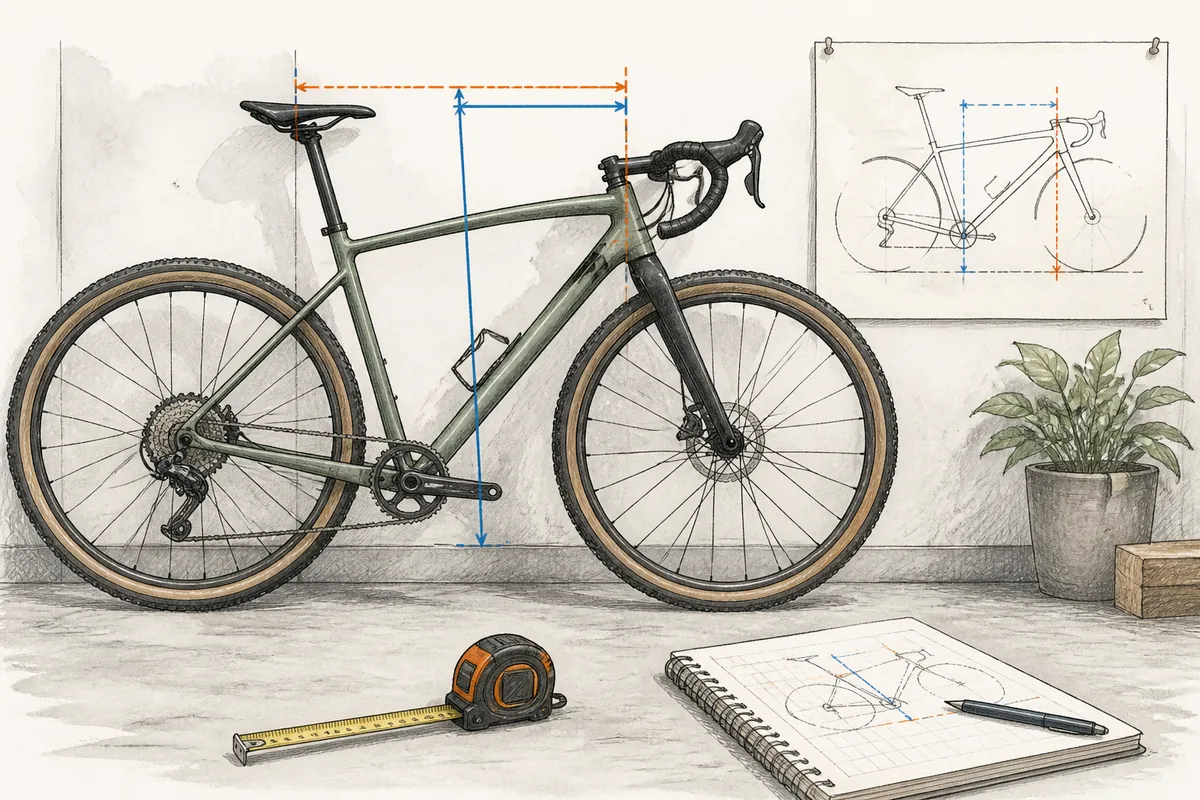
You do not need elaborate equipment for a useful initial check. A wall, tape measure, and firm book are enough. Measure barefoot, standing naturally, with your feet roughly shoulder-width apart. Do not stretch upward or force your posture into an exaggerated position.
For height, stand against a wall and mark the highest point of your head while looking straight ahead. Measure from the floor to that mark. For cycling inseam, place a firm book between your legs and press it upward with the same pressure you would use for a saddle. Keep the book level, then measure from the floor to its upper edge.
Take the inseam measurement twice, particularly if you are close to a size boundary. Small changes in foot position or book pressure can move the result enough to affect a borderline recommendation. Record it in centimeters as well as inches, since most manufacturer charts use metric figures.
For the full wall-and-book process, see how to measure your bike frame size. The important point here is consistency: use the same method each time and enter the result into the chart for the exact gravel bike you are considering.
Why the chart is only the first step
A frame size is not just a seat-tube number. Modern gravel bikes use sloping top tubes, different wheel sizes, and widely varying riding positions, so a 54cm frame from one brand may not fit like a 54cm frame from another.
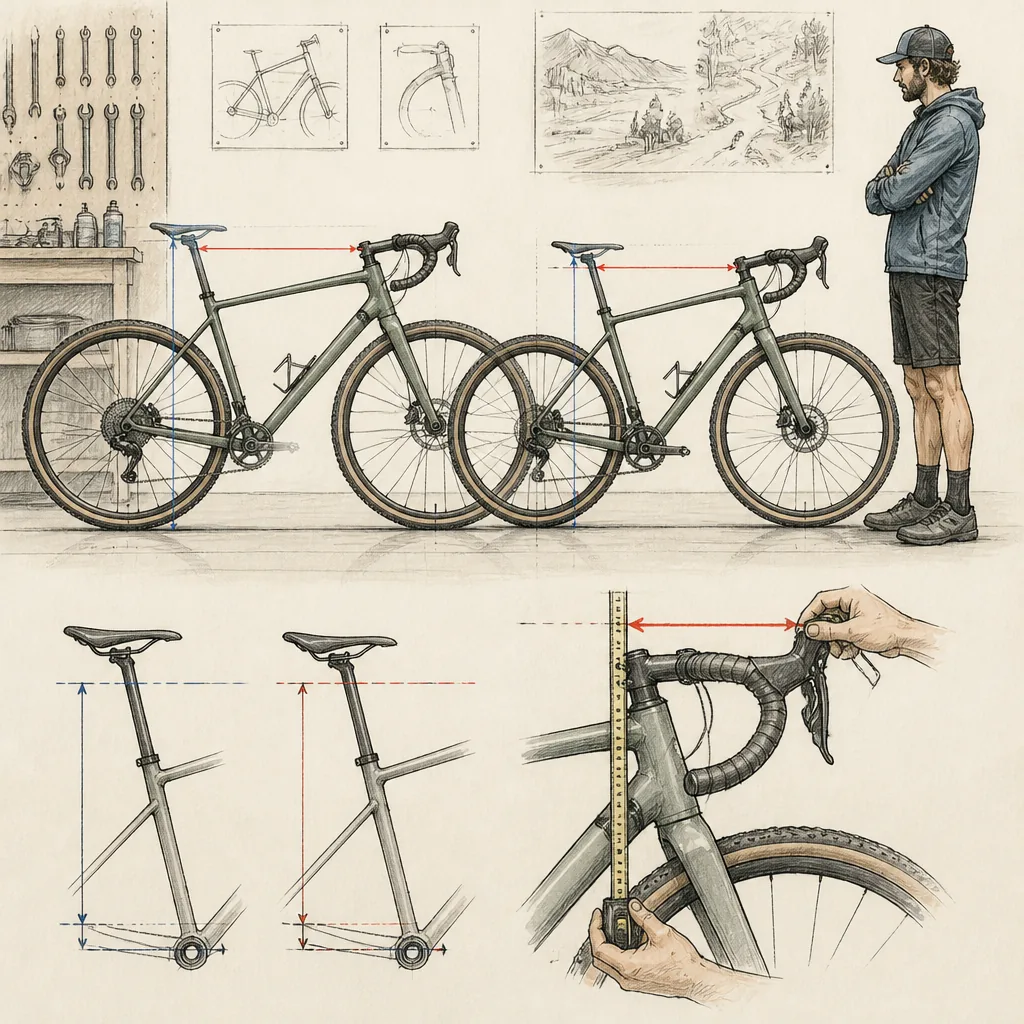
Once the basic size range is clear, stack and reach deserve more attention than the familiar medium, 54cm, or 56cm label.
| Measurement | What it changes on the bike |
|---|---|
| Stack | The vertical distance from the bottom-bracket area to the top of the head tube. More stack puts the handlebars higher and usually creates a more upright position. |
| Reach | The horizontal distance from the bottom-bracket area to the top of the head tube. More reach creates a longer cockpit; less reach brings the controls closer. |
| Wheelbase | A longer wheelbase generally adds stability on rough ground and during loaded rides. A shorter one can feel more agile. |
| Head angle | A slacker head angle usually contributes to steadier steering off-road. A steeper angle tends to feel quicker. |
| Seat angle | This affects where your hips sit in relation to the bottom bracket and changes how saddle height and reach feel. |
| Standover | The clearance between you and the top tube when standing over the bike. It matters for confidence, but is less useful as the main fit measurement on a sloping-top-tube frame. |
| Effective top tube | A horizontal top-tube comparison measurement. It can help, although stack and reach generally give a cleaner picture of frame proportions. |
Head-tube length, stem length, seat angle, and handlebar shape also affect the final position. A bike with a tall head tube and generous stack may suit long-distance gravel, while a bike with lower stack and longer reach may be aimed at riders who spend more time on smooth race courses.
The number on the frame is a label, not a universal unit of fit. Compare the geometry table instead of assuming all bikes with the same printed size are interchangeable.
Choosing between two gravel bike sizes
If you sit between sizes, start by comparing stack and reach rather than choosing automatically by height. As a general default, the smaller frame is usually the safer choice when you want a compact, manageable bike and its stack and reach suit your proportions.
The smaller option can feel more responsive and easier to handle on technical gravel. It may also give you more room to adjust the saddle and bars without creating a stretched-out position. Smaller is not automatically better, though. Chasing the lowest possible front end is a reliable way to turn a useful gravel bike into a posture experiment.
| Choose the smaller size when… | Choose the larger size when… |
|---|---|
| You have a shorter torso or prefer a compact cockpit. | You have a longer torso or arms and need more effective top-tube length. |
| You value nimble handling and a lower overall position. | You need more stack for comfort or a less aggressive position. |
| The saddle height, reach, and handlebar position fall safely within the adjustment range. | You prefer a calmer bike for long rides, rough surfaces, or loaded touring. |
| The larger size would require an unusually short stem. | The smaller size would require a tall stack of spacers or a very long stem. |
Saddle height, stem length, spacers within the manufacturer’s limits, handlebar reach and flare, and sometimes crank length can fine-tune a correctly chosen frame. They cannot cleanly repair every sizing mistake.
Excessive reach, poor standover clearance, a badly mismatched seat angle, or insufficient stack are structural problems. A very long stem can make steering feel slower and less natural. A tall stack of spacers may be outside the manufacturer’s approved setup and can leave you with a bike wearing a small chimney.
Use adjustment parts to refine a fit, not to disguise a fundamentally wrong frame size.
Gravel fit versus road bike fit
Gravel bikes use road-style drop bars and often road-like size labels, but their geometry can be quite different. An endurance-oriented gravel bike will commonly offer a taller front end, a shorter or more moderate reach, a longer wheelbase, and a more stable front end than an aggressive race-gravel bike.
That extra height and stability help beginners, long-distance riders, bikepackers, and anyone spending serious time on rough surfaces. A higher stack can reduce the need to force the handlebars low before your flexibility and control are ready for it. A longer wheelbase can make a loaded bike feel less nervous on loose ground.
Race-gravel bikes make more sense for experienced riders targeting fast events, smoother courses, and sustained aerodynamic positions. Their lower stack and longer reach can support a powerful, stretched-out position, but they are not automatically faster or more comfortable for ordinary mixed-surface riding.
Do not copy your road-bike size as a shortcut. Use your road bike as a comparison only if it fits well, then compare its actual stack and reach with the gravel bike. Two bikes marked 56cm can put your hands in noticeably different places.
Also account for the parts you will actually use. Wider tires can raise the bike slightly, flared handlebars can increase effective width and alter hand positions, and frame bags can change how you move around the bike. Winter clothing and a loaded handlebar bag do not transform the geometry, but they can make a marginally cramped cockpit less welcoming.
Common gravel bike sizing mistakes
The most common mistake is buying by height alone. Height narrows the search, but inseam, torso length, arm length, flexibility, and riding position determine whether the bike feels usable for hours rather than merely plausible in a shop.
- Assuming every medium, 54cm, or 56cm is equivalent. Size labels are not standardized across brands or models.
- Choosing the larger bike because it feels comfortable for five minutes. A roomy showroom position can become excessive reach over several hours.
- Choosing the smallest frame to get a low handlebar. A low front end is not useful if it compromises control or requires more flexibility than you have.
- Treating saddle height as a complete fit solution. Correct saddle height cannot compensate for unsuitable reach or stack.
- Ignoring small-frame details. Check tire clearance, wheel size, crank length, handlebar width, and listed stem length.
- Buying a professional fit before narrowing the choice. Most riders should first measure accurately, compare geometry, and choose a retailer with sensible returns.
If you develop persistent pain, stop treating the problem as a sizing puzzle and seek qualified bike-fit or medical advice. Fit information can narrow choices; it cannot diagnose an injury.
How to check a manufacturer’s gravel size chart before buying
Start with the manufacturer’s recommended height and inseam range. Treat that as the first filter, not the final verdict. Then open the geometry table for the exact model, because an endurance gravel bike and a race-gravel bike from the same company may use different proportions.
Compare stack and reach with a bike you already know fits, if you have one. Also check the listed saddle-height range, standover height, stem length, handlebar reach, and maximum permitted spacer height. These details tell you whether the suggested size can be set up without unusual parts.
For an online purchase, ask the retailer for the exact frame size and standard cockpit setup if you are close to a boundary. A retailer with straightforward returns is worth more than a small theoretical weight saving when you cannot sit on the bike first. Do not cut the steerer or replace fixed parts until you are confident the size is right.
A basic tape measure is enough for the initial measurements. A floor pump is useful once the bike arrives because tire pressure affects ride height, comfort, and handling, although it cannot solve an incorrect frame choice. An adjustable or replaceable stem can be a measured fit adjustment later; it should not be your sizing strategy from the start.
The practical answer: which gravel bike size should you buy?
Use this sequence:
- Measure your height and cycling inseam carefully.
- Use the manufacturer’s chart to find the likely size range.
- Compare stack and reach for the exact model.
- Choose the riding position you actually want: endurance and stable, or lower and more race-focused.
- Confirm that saddle height, cockpit length, and spacer limits allow a normal setup.
If your measurements sit comfortably inside one manufacturer’s range, that recommended size is the safest starting choice. If you are between sizes, favor the smaller frame for a compact, nimble fit, or the larger one when you need extra stack, have a long torso, or expect loaded long-distance riding.
The best size gives you a neutral saddle position, comfortable reach, controlled steering, and enough adjustment without heroic component swaps. Let the chart narrow the decision, then let the geometry decide it.
Gravel bike sizing questions that cause trouble
Should I choose the smaller or larger gravel bike size if I am between sizes?
Choose the smaller frame when its stack and reach give you a compact, manageable position and you value nimble handling. Choose the larger frame when you need more stack, have a long torso, or prioritize stability and comfort on loaded, long-distance rides. Do not make the decision from the size label alone.
Can I use my road bike size to choose a gravel bike?
Use it as a comparison point, not a direct answer. If the road bike fits well, compare its stack and reach with the gravel bike’s figures. Road-like labels are not standardized, and gravel bikes can be deliberately taller, shorter, or more stable.
Is inseam more important than height?
Inseam is often the better first check for saddle height and clearance, but it does not determine the whole fit. Torso length, arm length, flexibility, and preferred riding position decide whether the frame’s stack and reach work once the basic range is known.

I’ve spent way more time in the bike trade than anyone should reasonably want to. In that time I’ve wanted to make cycling jargon and marketing easier to cut through to help people get the bike of their dreams.
When I’m not writing about bikes, I can be seen out bikepacking on single speed bikes or teaching kids how to ride.