
Many cyclists make every ride harder than it needs to be. The easy ride turns into a moderate ride, the moderate ride becomes a race, and the next day is spent wondering why the legs feel like they have filed a formal complaint. Cycling training zones give you a simple way to control that effort.
A training zone is an effort range, not a magic physiological boundary. It helps you decide when to ride easily, when to hold a steady pace and when to push hard. The numbers are useful, but your breathing, recovery and ability to repeat an effort still matter more than pretending a watch has perfect knowledge of your body.
Assumes you can already balance and pedal. Explains zone concepts and practical starting points – not an FTP calculator, a 20-minute test walkthrough or a complete training plan.
What cycling training zones are for
Training zones divide effort into broad levels. The idea is straightforward: easy riding develops consistency and gives you useful time on the bike, while harder riding creates a stronger training stimulus but also demands more recovery.
Without some control, beginners often ride in the middle all the time. They are working too hard for a genuinely easy session and not hard enough to make a hard session especially productive. That is the cycling equivalent of leaving every gear slightly wrong.
Zones help you separate those jobs. They can guide a recovery spin, a long aerobic ride, a sustained climb or a short interval session. They also make pacing easier when you are learning how far beginners should cycle, because distance alone tells you very little about how demanding a route will be.
Zone percentages vary between systems and testing methods. Maximum heart rate, lactate threshold heart rate and FTP-based zones are not interchangeable. Treat the boundaries as useful estimates, then check whether the effort feels repeatable and appropriate for the ride.
For most beginners, the best starting point is RPE and the talk test. Build consistent riding habits before spending money on a power meter. Data is helpful, but collecting more numbers is not the same as training better.
The main cycling training zone systems compared
There are three practical ways to judge cycling intensity: heart rate, power and RPE. Speed, cadence and distance can add context, but they are poor substitutes for effort zones. A headwind can make the same speed exhausting, while a tailwind can make it look like you have briefly joined the WorldTour.
| System | What it measures and when it is most useful |
|---|---|
| Heart rate | Your body’s internal response to effort. A chest-strap heart-rate monitor gives useful feedback for steady aerobic rides. Heat, dehydration, stress, caffeine and fatigue can all change the reading. |
| Power | The work produced at the pedals, measured in watts. It responds immediately and is excellent for structured intervals and pacing. You need a power meter or smart trainer, plus a sensible FTP estimate. |
| RPE | Your rating of how difficult the effort feels. It costs nothing, responds instantly and works on hills, commutes and group rides. It is subjective, especially until you learn how different efforts feel. |
Heart rate is an internal response, so it can rise even when your effort stays constant. Power is an external output, so it tells you what you are producing right now, but it does not automatically tell you how recovered you are. RPE sits between the two: it is personal, immediate and often more informative than a suspiciously precise number.
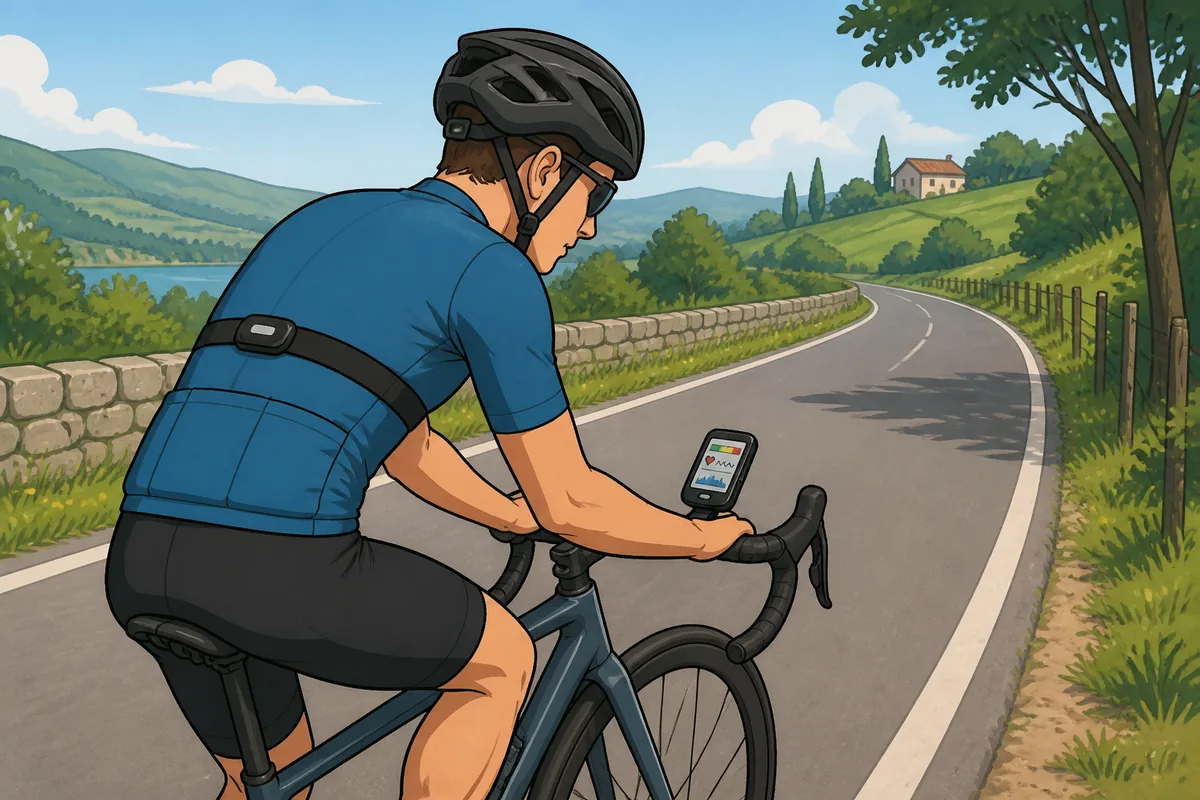
Cycling heart-rate zones: a practical starting point
A simple five-zone heart-rate model is useful for orientation. It is not a diagnosis, and formulas based on age can be substantially wrong for individual riders. Use the descriptions below alongside breathing and repeatability rather than treating a calculated maximum heart rate as laboratory truth.
| Zone | Practical description |
|---|---|
| Zone 1 | Very easy recovery riding. Breathing is relaxed and conversation is effortless. Useful for warming up, cooling down or turning the pedals after a harder day. |
| Zone 2 | Easy aerobic riding. You can speak in full sentences, although you are clearly exercising. This is a sensible intensity for many longer rides. |
| Zone 3 | Controlled but noticeably harder. Conversation becomes shorter and breathing is more deliberate. Useful for sustained tempo work, but tiring if every ride lives here. |
| Zone 4 | Hard and sustainable only for limited periods. You may manage short sentences, but the effort requires concentration and recovery. |
| Zone 5 | Very hard efforts with heavy breathing. This is generally used in short intervals rather than held continuously. |
Heart rate has a built-in delay. At the start of a hard interval, your legs may be working hard while your heart rate is still catching up. For that reason, heart rate is a poor sole target for short intervals. It is much more useful for checking longer efforts.
Heart rate can also drift upward during a long ride at the same power or pace. Heat, dehydration and fatigue are common reasons. A wrist-based optical sensor may be less consistent during hard efforts or when contact is poor; a chest strap is generally the better choice when heart-rate precision matters.
Use heart rate as a guide, not a command. If the number looks unusual but your breathing and RPE feel normal, consider the conditions before changing the whole ride.
Cycling power zones: where FTP fits
Power measures the work you are producing at the pedals in watts. Unlike heart rate, it responds immediately when you accelerate, ease off or start a climb. That makes it particularly useful for intervals and pacing efforts where waiting for your heart rate to catch up would be rather unhelpful.
Most power-zone systems use functional threshold power, or FTP, as their reference point. FTP is an estimate of the power you can sustain for a substantial effort, and the resulting zones are only as useful as that estimate. Testing method, fatigue and changing fitness all affect it.
For an explanation of FTP testing and zones, use that dedicated page rather than treating the material here as a second FTP calculator.
In practical terms, low power is used for recovery, moderate power for endurance, controlled hard power for tempo and threshold work, and very high power for short efforts above threshold. The advantage is precision: you can target a repeatable output rather than guessing from speed on a windy road.
The drawback is cost and interpretation. A power meter, including power meter pedals, adds expense, and a smart trainer can be overkill if you are not riding structured indoor sessions. Different bikes and trainers may not show exactly the same number, so consistency of equipment and calibration matters.
Power is also not a health or readiness meter. If you are ill, overheated or badly fatigued, forcing yourself to hold a target number is not clever training. Use RPE and heart rate as secondary checks, and stop if you experience concerning symptoms such as chest pain, fainting or unusual breathlessness. Seek appropriate medical advice rather than trying to out-stubborn the data.
RPE and the talk test: the zone system every cyclist already owns
RPE means rate of perceived exertion. You rate the effort from 1 to 10 based on breathing, muscular strain and how sustainable the pace feels.
| RPE | How it usually feels |
|---|---|
| 1-2 | Very easy. Relaxed breathing and no meaningful strain. |
| 3-4 | Easy endurance. Full conversation is comfortable and the effort can last a long time. |
| 5-6 | Steady and purposeful. You can speak in shorter sentences, but you are working. |
| 7-8 | Hard. Conversation is limited to a few words and the effort is sustainable only for a while. |
| 9 | Very hard. You are close to your limit and need substantial recovery. |
| 10 | Maximal. A brief sprint or final effort, not a normal training intensity. |
The talk test makes RPE easier to apply. Full conversation usually means easy work. Short sentences suggest a moderate effort. A few words indicate hard work. It is not a perfect measurement, but it is free, immediate and difficult to fool with a low battery.
RPE is especially useful for new riders, variable terrain, commuting, group rides and short sprints. It is also valuable when heart rate is affected by heat or poor sleep, or when power data is unavailable. Its weakness is subjectivity: motivation, stress and unfamiliar efforts can distort your rating. That improves with practice.
Which cycling training zones should you use?
There is no prize for buying the most sensors. Choose the system that answers the question you actually have.
| Your situation | Best starting tool |
|---|---|
| Beginner fitness riding | RPE plus the talk test. Learn easy, steady and hard before adding equipment. |
| Long steady rides | Heart rate and RPE. Heart rate gives a useful numerical check, while RPE handles hills and changing conditions. |
| Structured indoor intervals | Power from a smart trainer or power meter, with RPE as a reality check. |
| Variable group rides | RPE. Speed and heart rate can change quickly with terrain, drafting and attacks. |
| Monitoring fatigue on longer rides | RPE plus heart rate. A rising heart rate at the same effort can provide useful context, not an automatic reason to panic. |
For many cyclists, the best low-cost combination is RPE for controlling effort and heart rate for feedback on longer rides. Add power when you have a clear need to pace events or follow structured intervals. Do not buy a power meter before you have consistent riding habits or can explain what decision the data will improve.
FAQs
Can I train effectively without a heart-rate monitor or power meter?
Yes. RPE and the talk test are enough for most beginner endurance riding and can guide hard efforts once you learn how different intensities feel.
Why does my heart rate rise during a ride even when power stays the same?
Heat, dehydration, fatigue and cardiac drift can raise heart rate over time. Treat it as useful context rather than proof that your target power is wrong.
Should I use heart rate or power for cycling intervals?
Power responds immediately and is usually better for structured intervals. Heart rate and RPE remain valuable checks, especially when fatigue or heat changes the numbers.
Start with the tool you will use consistently. For most beginners, that means RPE and the talk test. Ride regularly, learn how your effort feels, and only upgrade to heart rate or power when you have a specific training question worth answering.

I’ve spent way more time in the bike trade than anyone should reasonably want to. In that time I’ve wanted to make cycling jargon and marketing easier to cut through to help people get the bike of their dreams.
When I’m not writing about bikes, I can be seen out bikepacking on single speed bikes or teaching kids how to ride.


