FTP (functional threshold power) is an estimate of the highest power you can sustain for about an hour. Training apps use it to set workout intensity, pace long efforts and track progress – it is not a cycling IQ score or a race result.
Do you need a formal FTP test? Beginners can often start with perceived effort or a smart-trainer estimate and retest later. Structured indoor plans and power-based outdoor intervals benefit more from a proper test (20-minute, ramp or similar). Details below.
Assumes you can already ride steadily and complete a sustained effort. Training and measurement guidance – not a learn-to-ride plan or a prescription for maximal exercise if you have medical concerns.
What FTP means in cycling
Functional threshold power is an estimate of the highest power you can sustain for roughly an hour under a defined set of conditions. Power is measured in watts, usually with a power meter or smart trainer. If your estimated FTP is 220 watts, training software can use that number to set easier endurance rides, sustained threshold intervals and harder high-intensity efforts.
The important word is estimate. FTP is not a directly measured physiological barrier that switches off at a precise wattage. Different tests, algorithms, equipment and pacing strategies can produce different results. A 20-minute test with a 95 percent adjustment will not necessarily give the same number as a ramp test, and an indoor result may not match an outdoor effort.
FTP is also not the same thing as your average power for a normal ride. Average power includes coasting, stops and easy sections. Normalized power is a different calculation intended to reflect the physiological cost of variable riding. Lactate threshold and FTP are related training concepts, but they are not interchangeable measurements, and FTP does not directly measure your VO2 max.
Nor is FTP the same as race pace. A short gravel climb, a bunch sprint and a three-hour sportive demand different combinations of power, positioning, handling, endurance and recovery. A rider with a lower FTP can still be quicker on a particular course by being more aerodynamic, pacing better or producing more power for short bursts.
FTP’s real value is simpler: it gives you a repeatable anchor. Instead of describing an interval as “quite hard”, you can set it at a percentage of FTP and compare similar sessions later. Training platforms use the number to calculate zones, while you can use it to pace a long climb or judge whether a workout is doing what it was meant to do.
That makes FTP a tool for training and pacing, not a complete measure of fitness, talent or cycling worth. If your zones make every easy ride hard, or your supposed threshold intervals feel suspiciously comfortable, the number needs questioning. You do not need to obey a spreadsheet into the ditch.
How FTP is tested
There are several practical ways to estimate FTP. The main choices are a true 60-minute effort, a 20-minute test, a ramp test and shorter time-trial-style estimates. None is automatically “the real FTP”; each tests a slightly different slice of your ability and applies its own assumptions.
| Test | Best use and main tradeoff |
|---|---|
| 60-minute effort | Most specific to roughly hour-long sustainable power, but difficult to pace and physically demanding. Small pacing mistakes can spoil the result. |
| 20-minute test | A practical, repeatable option. It requires pacing and preparation, then normally uses a 95 percent adjustment to estimate FTP. |
| Ramp test | Power increases in steps until you cannot continue. It is simpler to pace, but the reported FTP depends heavily on the platform’s algorithm and your power profile. |
| Shorter estimate | Useful when time is limited or for a rough starting point, but generally less specific than a longer sustained effort. |
For the standard 20-minute method, warm up according to the test instructions, then complete the hardest sustainable 20-minute effort you can pace evenly. Take the average power from that effort and multiply it by 0.95. The adjustment attempts to account for the fact that most riders cannot sustain their 20-minute power for an hour.
Pacing a 20-minute test: start controlled rather than heroic for the first five minutes, settle into the hardest power you believe you can hold through the middle ten minutes, then lift only if you still have something left in the final five. A faded last third usually means you opened too hard; a huge finish often means you sandbagged the middle.
That formula is a convention, not a law of cycling physics. Riders with strong short-duration power, unusual fatigue resistance or limited endurance may find that 95 percent overestimates or underestimates their longer-duration ability. It remains useful when applied consistently, especially for comparing your own results over time.
A ramp test works differently. The trainer raises resistance in regular steps until you stop or cannot maintain the required cadence. The software then estimates FTP from the completed effort. Because the calculation varies between platforms, enter the reported result as your FTP. Do not apply the 95 percent factor again if the software has already built an adjustment into its estimate.
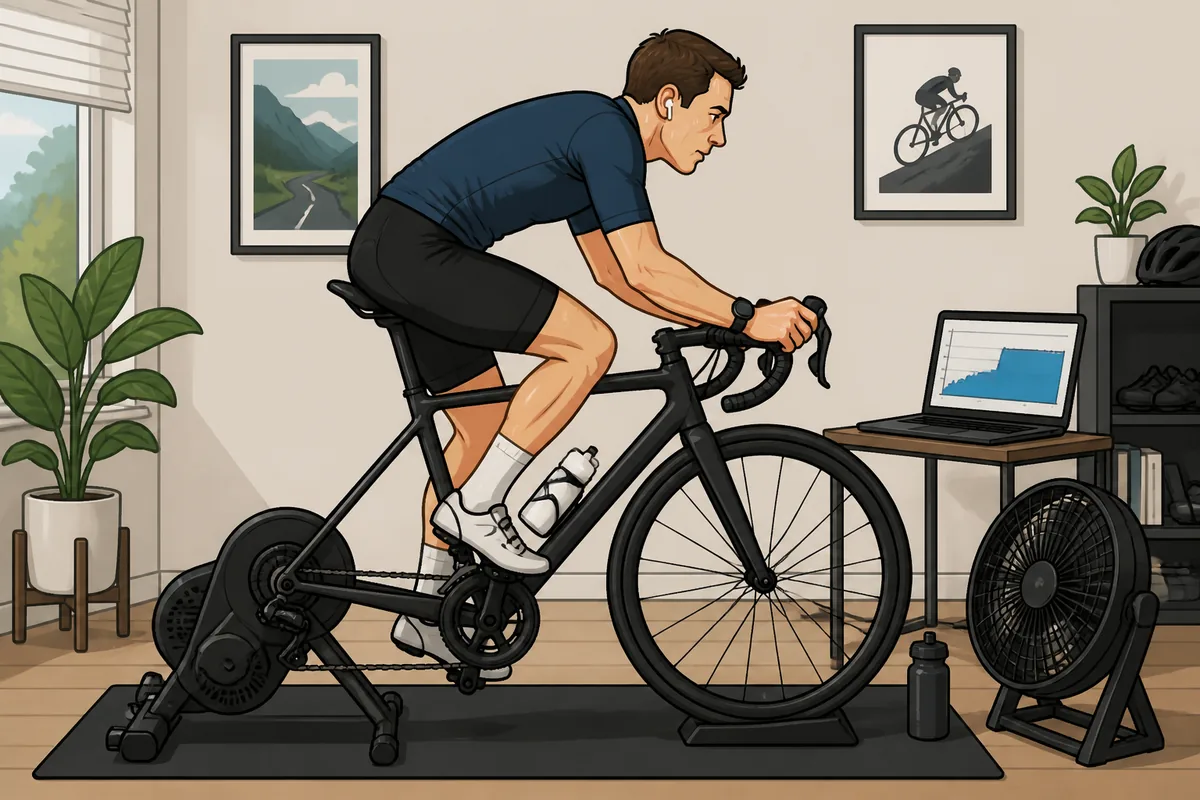
A 60-minute test is more specific in theory, but it is a poor default for many riders. It takes more time, requires excellent pacing and creates considerable fatigue. A slightly uneven effort can leave you with a number that says as much about that day’s motivation and weather as it does about your training.
For most beginners and recreational riders starting structured training, a repeatable ramp or 20-minute test is the sensible place to begin. You get a usable reference without turning every test into an endurance trial by ordeal. A Peloton FTP test follows the same general principle of using a defined effort to establish a training reference, although its protocol and calculation should be treated on its own terms.
Keep the test conditions as consistent as possible. Use the same power meter or smart trainer, calibrate it according to the manufacturer’s instructions, and record whether the result came from indoor or outdoor riding. Cooling matters indoors, as do fueling, cadence, fatigue and riding position. A Wahoo KICKR, Elite Suito, 4iiii power meter or Garmin Rally pedals may report useful power data, but changing between devices can introduce differences that look like fitness gains.
Do not test when you are ill, unusually fatigued, under-fueled or riding in excessive heat. Riders unfamiliar with pacing are better served by a controlled ramp test or a non-maximal starting estimate than by immediately attempting a heroic hour. If maximal exercise brings chest pain, fainting or unusual breathlessness, stop rather than forcing the test and seek appropriate medical advice.
FTP calculator: estimate your number
Use the calculator for a quick estimate from a 20-minute average, or enter a platform FTP you already have to see approximate training zones. The maths behind the 20-minute method is:
Estimated FTP = average power from the 20-minute effort x 0.95
Ramp-test users: choose “FTP I already have” and enter the platform’s reported FTP. Do not apply 0.95 again.
Worked examples if you prefer to do it by hand: 240 watts x 0.95 gives an estimated FTP of 228 watts. If your 20-minute average is 180 watts, the calculation is 180 x 0.95 = 171 watts.
This is an estimate, and the 95 percent factor is not equally accurate for every rider. Strong sprinters, riders with unusual fatigue resistance and riders with limited endurance can all produce a result that does not line up neatly with an hour-long effort. Consistency matters more than pretending the final watt is a laboratory truth.
If you used a ramp test, choose “FTP I already have” and enter the platform’s reported number. Do not put a ramp-test result through the 20-minute formula unless the platform specifically says its number is unadjusted. Applying the factor twice will set your training zones unnecessarily low.
To calculate watts per kilogram, divide FTP by body mass in kilograms:
W/kg = FTP in watts / body mass in kilograms
A 228-watt FTP at 76 kg is 3.0 W/kg. W/kg can help put climbing performance into context, but it is not a health score or a moral grade. Do not manipulate body weight to improve the number; a smaller number on a scale is not automatically better training.
Once you have a result, enter it into your training platform, record the date, device and test protocol, and set your zones. Compare future results with the same power source where possible. Retest when there is a clear reason, such as sustained improvement, a return from a long break or repeated evidence that the zones no longer fit. Testing every few days mostly turns training into a recurring exam.
Cycling power zones based on FTP
Once you have a usable FTP estimate, you can turn it into training zones. The calculator above can fill approximate Zone 1-7 ranges from your number. The seven-zone model below is commonly used, although platforms may use slightly different boundaries or names. The static example wattages use an FTP of 250 watts and are rounded for practical use.
| Zone and purpose | Approximate percentage of FTP, feel and typical use |
|---|---|
| Zone 1: Recovery | Below 56%: Below 140 W for a 250 W FTP. Very easy spinning, used for recovery rides, warm-ups and cool-downs. |
| Zone 2: Endurance | 56-75%: About 140-188 W. Comfortable and sustainable, with conversation possible. Supports longer aerobic rides. |
| Zone 3: Tempo | 76-90%: About 190-225 W. Firm and controlled. Useful for steady climbing and sustained moderate work. |
| Zone 4: Threshold | 91-105%: About 228-263 W. Hard, with conversation limited. Used for sustained intervals near the FTP estimate. |
| Zone 5: VO2 max | 106-120%: About 265-300 W. Very hard efforts lasting several minutes, normally used in structured intervals. |
| Zone 6: Anaerobic capacity | 121-150%: About 303-375 W. Short, severe efforts lasting seconds to a few minutes. |
| Zone 7: Neuromuscular power | Above 150%: Above 375 W. Maximal or near-maximal sprints lasting only a few seconds; peak power matters more than a precise target. |
Zone 2 is useful, but it is not a magic switch. If a planned endurance ride spends long periods in Zone 3 or Zone 4, it may create more fatigue than intended. That does not make the ride worthless; it means the session has changed its training cost and purpose.
These zones are only as useful as the FTP behind them. If the test was poorly paced or the power data is unreliable, precise-looking zone numbers merely give the mistake a spreadsheet. Boundaries vary by platform and testing method.
FTP benchmarks: what counts as good?
There is no single FTP number that makes you a “good” cyclist. Absolute watts favour heavier riders, while watts per kilogram favour lighter riders, and neither tells us everything about speed. Aerodynamics, handling, tactics, terrain, fatigue resistance and the ability to repeat hard efforts all matter.
The following bands are deliberately broad and illustrative for recreational cyclists. They are not race-selection standards, medical thresholds or promises about finishing times.
| Broad rider category | Illustrative W/kg range and sensible interpretation |
|---|---|
| New or occasional structured rider | Below roughly 2.0 W/kg. Focus on consistent riding, comfortable endurance and learning to pace efforts. |
| Regular recreational rider | Roughly 2.0-3.0 W/kg. This covers a wide range of cyclists and supports improvement without turning every ride into training camp. |
| Well-trained amateur | Roughly 3.0-4.0 W/kg. Training history, body composition, event type and testing method matter increasingly. |
| Highly trained amateur | Above roughly 4.0 W/kg. This is not a sensible target for everyone, and comparisons are unreliable without consistent testing conditions. |
Professional benchmarks belong in a different conversation. Elite riders have years of specific training, carefully managed recovery and exceptional physiology. Copying their numbers is about as useful as using a Formula 1 fuel strategy for the school run.
Indoor and outdoor FTP results can differ because of cooling, trainer resistance, riding position, motivation, fatigue and the location of the power measurement. The safest comparison is your own number against an earlier result from the same device, protocol and broadly similar conditions.
How to use FTP in a training plan
FTP becomes useful when it changes what you do on the bike. You can use it to set interval targets, pace a sustained climb, control an indoor workout or estimate training load. Progressive overload might mean extending an endurance ride, adding a little interval duration or increasing session frequency. Avoid changing duration, intensity and frequency all at once. Recovery is part of the plan.
Consider updating FTP after a clear sustained improvement, a return from a long break, a major change in equipment or protocol, or repeated evidence that your zones no longer match the effort. Every six to eight weeks is a reasonable starting point for structured training, but the calendar should not force a test when the result will change nothing.
Your FTP may be set too high if easy rides regularly become hard, intervals are repeatedly impossible, recovery worsens or normal training cannot be completed. It may be set too low if threshold work is consistently comfortable and real-world performance sits well above the target. Perceived exertion, heart rate and the talk test are useful cross-checks, especially in heat, fatigue or short efforts.
Common FTP mistakes and limitations
- Testing while ill, unusually fatigued, under-fueled or overheated.
- Changing between a power meter, smart trainer or app and treating readings as directly comparable.
- Applying the 95 percent adjustment to a ramp-test result that has already been calculated by the platform.
- Assuming FTP is a fixed physiological truth rather than an estimate tied to a protocol.
- Using one bad test to rewrite every training zone.
- Ignoring differences between indoor and outdoor cooling, position and motivation.
- Chasing a higher FTP at the expense of recovery, enjoyment or event-specific skills.
If you experience chest pain, fainting or unusual breathlessness, stop the effort and seek appropriate medical advice. Riders with known cardiovascular concerns or other relevant medical conditions should get suitable guidance before attempting a maximal test; the NHS exercise guidance is a sensible starting point for general information.
The practical answer: do you need to test your FTP?
Testing is worthwhile if you follow structured power-based training, use a smart trainer or power meter, or need repeatable pacing for an event. Choose one protocol, standardize your equipment and conditions, complete the effort safely, calculate or record the result, and use it for several weeks before judging whether it helped.
If you ride casually, you can train effectively with perceived effort, heart rate, ride duration and repeatable routes. Most beginners overbuy into power-based training before building consistent riding habits. A correctly fitted bike, reliable floor pump and regular riding usually matter first.
FTP is a useful speedometer for training intensity, not a verdict on your ability as a cyclist. Start with a repeatable test only when you have a decision to make, then let your training and riding performance tell you whether the number is earning its keep.
Frequently asked questions
Why is my indoor FTP different from my outdoor FTP?
Cooling, trainer settings, riding position, motivation, fatigue and whether power is measured at the pedals, crank or hub can all change the result. Compare like with like whenever possible, and do not treat a device change as proof of a sudden fitness gain.
Can I apply the 95 percent formula to a ramp-test result?
Usually not. Ramp-test software normally applies its own estimate from the final completed step. Applying 0.95 again can set your FTP and every resulting zone unnecessarily low. Check what your platform’s reported number represents before doing the maths.
What is a good FTP for beginners?
There is no single good number. Absolute watts and W/kg both depend on body mass, testing method and riding history. For a new structured rider, a usable, repeatable estimate that makes easy rides feel easy matters more than matching someone else’s benchmark table.
How often should I retest FTP?
Every six to eight weeks is a reasonable default for structured training, or sooner after a clear block of progress, a long break or repeated evidence that your zones no longer match the effort. Retesting every few days mostly turns training into an exam.
Why did my FTP drop?
Heat, illness, poor pacing, under-fueling, a different device, weaker cooling indoors or simply a bad day can all lower a result. Treat one soft test as information, not a verdict, and compare it with how your usual Zone 2 and threshold sessions feel.
Is Peloton FTP the same as this calculator?
Peloton uses its own test protocol and reporting. The principle is similar-a defined effort to set a training reference-but you should follow Peloton’s number inside that ecosystem rather than forcing the 20-minute x 0.95 formula onto a different test. See our Peloton FTP test guide for that workflow.
Can I estimate FTP without a power meter?
Not accurately in watts. Heart rate, perceived effort and repeatable routes can still guide intensity, but they do not produce a true FTP in watts. If you only need conversational pacing, you may not need a power-based FTP at all.

I’ve spent way more time in the bike trade than anyone should reasonably want to. In that time I’ve wanted to make cycling jargon and marketing easier to cut through to help people get the bike of their dreams.
When I’m not writing about bikes, I can be seen out bikepacking on single speed bikes or teaching kids how to ride.