
If you are buying or already own an e-bike, the battery is often its most expensive replaceable component. That makes the question “how long do electric bike batteries last?” more useful than another argument about motor wattage.
For most modern lithium-ion e-bike batteries, a sensible starting estimate is around 3 to 5 years of useful service. That is not an expiry date. Capacity normally declines gradually, so a battery may still work after five years but provide less range than it did when new.
Covers rechargeable lithium-ion batteries used by most modern e-bikes – not battery repair or electrical diagnosis. A damaged, swollen or unusually hot battery should be taken out of service and assessed by the manufacturer or a qualified professional.
The short answer: expect several years, not forever
Manufacturers may quote a charge-cycle rating, but that number does not promise the battery will retain its original range for every one of those cycles. It is an estimate based on particular cells, testing conditions and a definition of how much capacity remains acceptable.
Battery aging is also different from battery safety. Shorter range, a quicker fall in the battery display or reduced performance under load can be normal signs of aging. Swelling, a cracked case, liquid, smoke, an unusual smell or extreme heat are safety concerns. Stop using and charging the battery if you notice those symptoms.
There are three useful ways to discuss electric bike battery life:
- Calendar age: how many years have passed since manufacture or regular use.
- Charge cycles: how many equivalent full uses the battery has completed.
- Miles: how far the battery has helped you travel.
Those measures overlap, but they are not interchangeable. A five-year-old battery used gently may be healthier than a two-year-old battery that has spent its life climbing steep hills with heavy cargo.
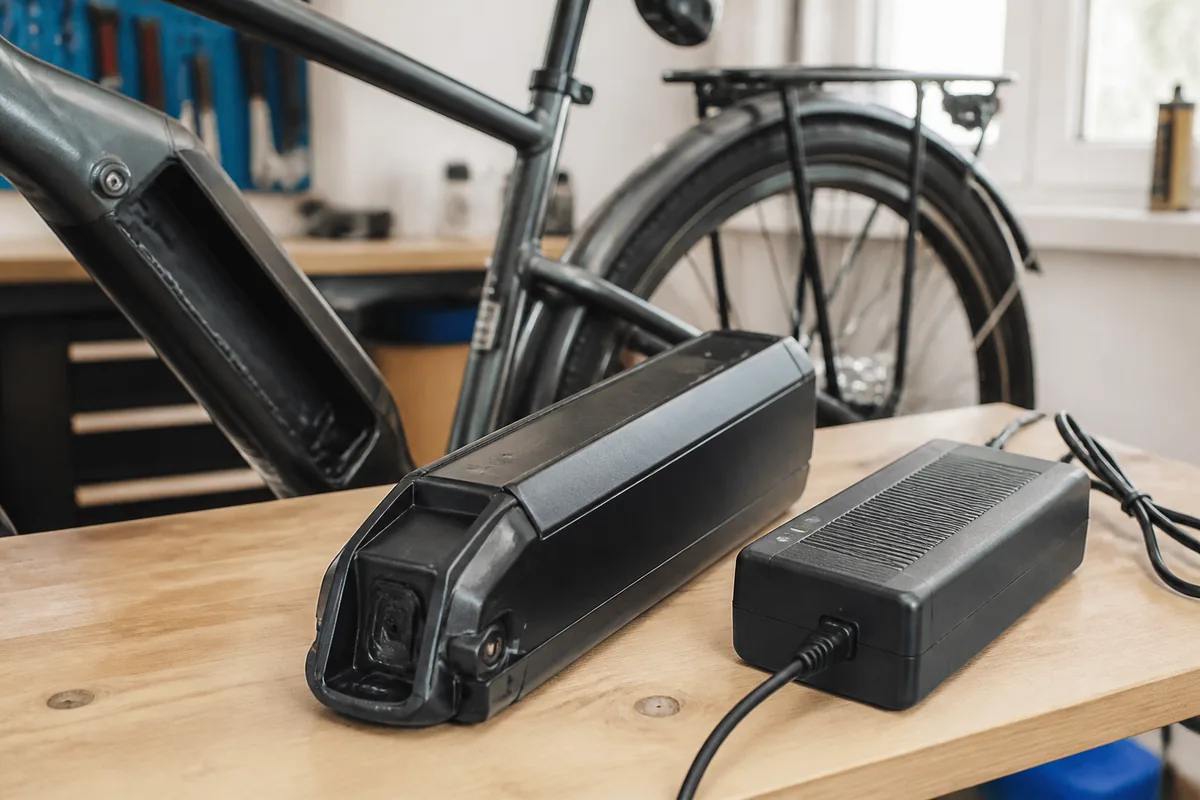
How long do electric bike batteries last in years, miles and charge cycles?
Calendar age matters because lithium-ion chemistry gradually changes even when the battery is not being ridden. Heat speeds that process up, as does leaving a battery at full charge for long periods. A battery stored in a hot vehicle is having a worse retirement than one kept indoors in a cool, dry place.
A charge cycle is not simply one visit to the charger. One full-equivalent cycle means using 100% of the battery’s capacity in total. If you use half the battery, recharge it, and later use another half, that is roughly one full cycle. Two 25% discharges are roughly half a cycle.
Many lithium-ion e-bike batteries are rated somewhere around 500 to 1,000 full-equivalent cycles. Treat that as a broad guide, not a universal specification. Cell quality, the battery management system, temperature, discharge rate and the manufacturer’s testing method all affect the result.
Miles are even less reliable as a standalone measure. Consider this illustrative calculation:
- A battery gives you 40 miles of real-world range.
- It completes 500 full-equivalent cycles.
- 40 multiplied by 500 equals a theoretical 20,000 miles.
That does not mean your battery is guaranteed to last 20,000 miles. Range changes with hills, wind, rider weight, tire pressure, assist level and temperature. As the battery ages, its range also falls, so the calculation explains the relationship rather than predicting your ownership cost.
| Measure | What it tells you |
|---|---|
| Years | Calendar aging. Heat and long periods at full charge can shorten useful life even when mileage is low. |
| Charge cycles | Equivalent full uses of the battery. Several partial discharges can add up to one cycle. |
| Miles | A rough output figure that depends heavily on terrain, weather, assist mode, rider weight, cargo and range. |
For comparing battery specifications, charge cycles are usually more useful than mileage. For deciding whether your own battery needs replacing, usable range matters more than either number. How far a particular e-bike travels per charge also depends on assist level, terrain, load and temperature-not only the battery’s rated capacity.
What shortens an e-bike battery’s life?
Heat is the main enemy. Direct sun, a hot car, an unventilated shed and charging in a hot garage all put extra stress on lithium-ion cells. Do not leave the battery in a vehicle all afternoon and expect it to age gracefully.
Cold weather is slightly different. Low temperatures can temporarily reduce range, so a winter ride may look worse without indicating permanent damage. Let a very cold battery return to a suitable indoor temperature before charging, following the instructions for your specific system.
Long-term storage at either 100% or completely empty is a poor default. If you are putting the bike away for weeks or months, follow the maker’s storage-charge guidance. When no specific instruction is available, a moderate partial charge is generally more sensible than either extreme.
High loads also increase battery work and heat. Steep climbs, maximum assist, heavy cargo, strong headwinds and underinflated tires all demand more current. You do not need to ride everywhere in the lowest assist mode, but correct tire pressure and sensible assist levels help both range and long-term battery workload.
Use the correct charger supplied with the bike, or one explicitly approved by the manufacturer. An unbranded substitute may have the wrong voltage, connector or charging characteristics. Frequent small top-ups are not automatically harmful; modern lithium-ion batteries do not need deliberate full discharges.
How to make an e-bike battery last longer
- Store it somewhere cool and dry. Indoors is usually better than a freezing shed, damp garage or hot vehicle. Keep it away from direct sunlight.
- Follow the manufacturer’s storage guidance. If no exact percentage is specified, use a moderate partial charge for long-term storage rather than leaving the pack full or empty.
- Let it cool after hard use. Give the battery time to return to a normal temperature before charging.
- Avoid repeated deep discharges. Recharge before the battery is routinely run completely flat, while following the instructions for your particular system.
- Reduce unnecessary load. Keep tires properly inflated, use the lowest assist that suits the route and avoid carrying weight you do not need.
- Use the supplied or approved charger. Do not experiment with chargers because the plug happens to fit.
The safest default is simple: do not open a lithium-ion battery pack yourself. Cell balancing, pack rebuilding and fault diagnosis are jobs for the manufacturer or a qualified battery specialist, not a rainy Sunday project with a screwdriver.
How to tell when your e-bike battery needs replacing
The clearest sign of capacity loss is noticeably shorter range in conditions that used to be comparable. You may also see the battery display fall quickly under load, show inconsistent readings or shut the bike down before the display reaches empty.
One poor ride is not proof of battery failure. Compare several rides with similar temperature, route, tire pressure, assist mode and rider load. A cold, windy climb with soft tires is not a fair battery health test; it is merely an efficient way to make every battery look guilty.
A battery can still function while no longer meeting your practical needs. If it used to cover your commute and now needs charging halfway through, replacement may be justified even if the pack is not completely dead. Battery replacement is a use-case decision, not an automatic punishment for reaching a particular birthday.
Stop using and charging the battery if it is swollen, cracked, leaking or unusually hot, or if you notice smoke or an unusual odor. Keep people and flammable materials away if it is safe to do so, and contact the manufacturer, emergency services or qualified service as appropriate. Do not attempt to open or repair a visibly damaged pack.
Before buying a replacement, check more than capacity. The new battery must match the system’s:
- Voltage and electrical specifications
- Connector and mounting system
- Firmware or communications compatibility
- Charger requirements
- Physical dimensions and locking hardware
Two batteries can look similar and still be electrically incompatible. Capacity alone is not a compatibility test.
Is replacing an e-bike battery worth it?
Replacement is usually worth considering when the bike is otherwise sound, the motor and electronics are still supported, and the frame and components fit your regular use. A new battery can restore useful range without forcing you to replace a perfectly good motor, drivetrain or set of wheels.
First check the battery and bike with the manufacturer or a qualified service provider. A diagnostic check can separate ordinary capacity loss from a charger, connection, display or control-system fault. Replacing the pack is expensive if the actual problem is elsewhere.
Be skeptical of the cheapest unknown replacement battery. Unclear cell quality, missing safety information, poor warranty support and uncertain compatibility make a low price a false economy. A genuine compatible battery with manufacturer or qualified-service backing is the safest starting choice.
Compare the replacement cost with the condition and value of the complete bike. Older proprietary systems may have limited parts support, and a battery is not much use if the manufacturer no longer supports the electronics. But do not assume an aging battery means the whole e-bike is finished.
Frequently asked questions
Should I leave my e-bike battery charging overnight?
Follow the manufacturer’s charging instructions, use the correct charger and avoid unattended or overnight charging, particularly on a flammable surface. Charging in a cool, clear area is the safer habit.
Can an e-bike battery be repaired or refurbished?
Some batteries can be professionally assessed or refurbished, but do not open or rebuild a lithium-ion pack yourself. Use the manufacturer or a qualified battery specialist.
Is it bad to fully discharge an e-bike battery?
Repeated deep discharges add stress and can leave you stranded. Recharge before the battery is routinely run completely flat, while following the guidance for your specific system.
Expect several useful years rather than a fixed number of miles. Keep the battery cool, use the correct charger, avoid routine deep discharges and judge replacement by the range you actually need. If the pack is damaged, swollen or overheating, stop charging and get qualified advice instead of trying to save a few dollars.

I’ve spent way more time in the bike trade than anyone should reasonably want to. In that time I’ve wanted to make cycling jargon and marketing easier to cut through to help people get the bike of their dreams.
When I’m not writing about bikes, I can be seen out bikepacking on single speed bikes or teaching kids how to ride.