Shimano’s groupset lineup used to be fairly easy to understand.
You started with Tourney or Altus, moved through Acera and Alivio, then eventually reached Deore and beyond.
Now things are changing.
Shimano CUES has started replacing a large part of that lower and mid-range lineup, which is why many riders suddenly find themselves comparing CUES and Deore.
The confusing part is that they overlap more than people expect.
Some bikes that would previously have used Alivio or Deore now come with CUES instead, and on paper the specs can look surprisingly similar.
The real difference is not just performance. It is philosophy.
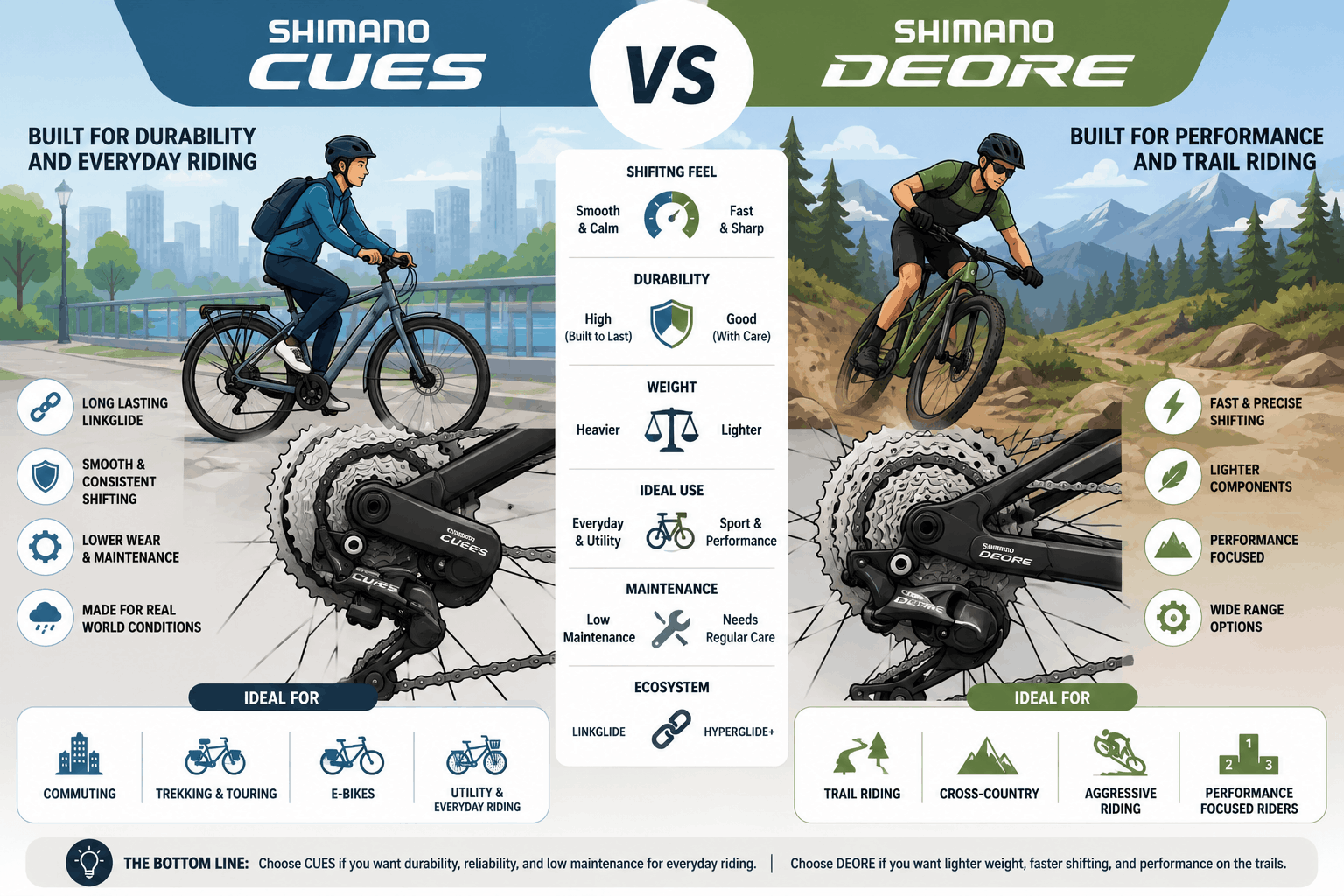
Deore is still performance-focused.
CUES is built around durability and simplicity.
Neither one is “better” in every situation. It depends on how and where you ride.
What Shimano CUES is actually trying to do
CUES is not just another groupset. It is Shimano trying to simplify a very fragmented part of its lineup.
Instead of having multiple overlapping entry and mid-range groupsets, Shimano is gradually moving many bikes toward the CUES ecosystem.
The focus is less on outright performance and more on:
- durability
- consistency
- reduced maintenance
- better longevity under heavy use
This is especially important now that bikes are being used for far more than traditional cycling.
Commuting, e-bikes, mixed-terrain riding, bikepacking, and everyday transport all put different stresses on drivetrains.
CUES was designed with that in mind.
What Deore is still built around
Deore comes from Shimano’s mountain bike side.
Even though modern Deore is very accessible in price, it still carries a lot of that trail-focused DNA.
- Faster shifting
- Lighter feel
- More performance-oriented setup
- Better suited to aggressive riding
Deore is designed for riders who care about how sharp and responsive the bike feels under effort.
You notice this most when climbing hard, shifting under load, or riding technical terrain.
Where they sit in Shimano’s lineup
This is where things become slightly messy. Traditionally, Deore sat clearly above groupsets like Acera and Alivio. CUES now overlaps much of that territory.
In many cases, modern CUES bikes are replacing what would previously have been:
- Alivio bikes
- Acera bikes
- some lower-end Deore bikes
That creates a strange situation where price alone no longer tells you much.
You can now find CUES-equipped bikes sitting very close to Deore-equipped bikes in cost.
The decision becomes less about “better” and more about which type of riding the bike is aimed at.
What the shifting actually feels like
This is where the difference becomes obvious.
Deore feels sharper.
Shifts happen faster and with a bit more immediacy. When you push hard on the pedals and shift at the same time, the drivetrain feels eager to respond.
It has a more sporty character.
CUES feels calmer.
The shifts are smoother and slightly less aggressive. Instead of snapping between gears, it transitions more gradually.
Some riders may interpret this as slower. Others will simply feel it as smoother and less harsh.
The interesting thing is that CUES tends to maintain this feel even when the drivetrain gets dirty or slightly neglected. That is very much intentional.
What you notice on climbs
Deore feels more responsive when climbing hard.
If you suddenly need to shift under pressure, especially on steep terrain, it reacts quickly. This matters more for trail riders and mountain bikers who constantly change pace and cadence.
CUES behaves differently.
It prefers smoother inputs and steady riding rather than aggressive riding. On commuting bikes, trekking bikes, and mixed-use bikes, this actually feels very natural.
The drivetrain feels composed rather than urgent.
Durability is where CUES makes its real argument
This is the entire reason Shimano created the system.
Modern drivetrains wear faster than many riders expect, especially under:
- heavy mileage
- poor weather
- e-bike torque
- inconsistent maintenance
CUES was designed to survive this kind of use better.
The drivetrain components are heavier and more robust, particularly around the cassette and chain interface.
This is one of the reasons CUES components can feel less “crisp” than Deore.
Shimano deliberately traded a bit of sharpness for longevity. For many everyday riders, that is actually a smart trade.
Weight differences
Deore is lighter.
Not massively lighter, but enough that performance-focused riders will notice it.
CUES components tend to be slightly heavier because durability is prioritized over saving grams.
For commuting or recreational riding, this rarely matters.
For trail riding or longer climbs, some riders will prefer the lighter feel of Deore.
Maintenance and real-world ownership
This is another area where the two systems start to separate.
Deore performs best when it is properly maintained.
Clean drivetrain, accurate indexing, fresh chain. When everything is dialed in, it feels excellent.
CUES is more forgiving. It tolerates neglect better.
If the drivetrain gets dirty, slightly worn, or ridden through bad weather regularly, CUES tends to stay consistent for longer.
This is why it makes so much sense on commuter and utility bikes.
The rider is not expected to constantly fine-tune everything.
Where each groupset starts to make sense
At this point, the difference becomes easier to understand.
Deore makes more sense when:
- performance matters
- you ride trails aggressively
- you value fast shifting feel
- you maintain your bike regularly
CUES makes more sense when:
- durability matters most
- the bike is used daily
- maintenance is less frequent
- the riding is more practical than performance-focused
Compatibility differences
This is one of the areas where riders get confused most quickly.
CUES is part of Shimano’s newer ecosystem, and that means not everything mixes cleanly with older Shimano drivetrains.
Deore still sits within Shimano’s more traditional MTB compatibility structure.
In practical terms:
- Deore components are generally easier to mix with existing Shimano MTB setups
- CUES is more self-contained and designed around its own ecosystem
This matters if you upgrade parts gradually.
With Deore, riders often replace one component at a time over the years.
CUES is more about running the system as a complete package.
That is partly why Shimano created it. Simpler compatibility, fewer combinations, fewer headaches for everyday riders and bike shops.
For enthusiasts, though, it can feel slightly more restrictive.
How they feel on different types of bikes
The same groupset can feel very different depending on the bike underneath it.
Deore on a proper trail bike feels lively and responsive.
The drivetrain reacts quickly, encourages harder riding, and suits bikes that are designed to be pushed.
CUES on a commuter or trekking bike feels solid and dependable.
The bike feels like it wants to keep moving steadily rather than aggressively.
This is why comparing them purely on specs can miss the point a bit.
They are designed around slightly different riding experiences.

Which one is better for mountain biking?
For proper trail riding, Deore is still the stronger option.
The drivetrain feels quicker, lighter, and more responsive when terrain gets technical.
You notice it most when:
- climbing steep trails
- shifting under pressure
- riding aggressively through changing terrain
CUES can absolutely handle off-road riding, but it feels calmer and less performance-oriented.
It suits recreational MTB riding more than aggressive trail riding.
If the bike spends most of its life on proper MTB trails, Deore still makes more sense.
Which one is better for commuting and everyday riding?
This is where CUES becomes very appealing.
Commuting and utility riding place very different demands on a drivetrain.
You deal with:
- bad weather
- inconsistent maintenance
- heavy loads
- constant stop-start riding
In these situations, ultimate shifting sharpness matters less than consistency and durability.
CUES was designed specifically with this type of use in mind. For many riders, it is actually the smarter real-world option.
What about e-bikes?
This is another major reason Shimano pushed CUES so heavily.
E-bikes put far more stress through the drivetrain than regular bikes.
The extra torque accelerates wear, especially on chains and cassettes.
CUES was designed to tolerate this better over time.
That is why you are now seeing it appear on a lot of mid-range e-bikes.
Deore still works well on e-bikes, but CUES is arguably the more practical system for high-mileage electric riding.
Which one feels better long-term?
This depends heavily on the type of rider you are.
Deore feels better when everything is fresh and perfectly adjusted.
The bike feels sharper, lighter, and more performance-focused.
CUES tends to feel more consistent over time.
Even as conditions worsen or maintenance gets delayed, the drivetrain still behaves predictably.
This is probably the best way to describe the difference overall.
Deore prioritizes feel.
CUES prioritizes consistency.
Who should choose Shimano CUES?
- Commuters
- E-bike riders
- Casual and recreational cyclists
- Riders prioritizing durability
- Anyone wanting lower-maintenance ownership
CUES makes a lot of sense when the bike is used heavily but not obsessively maintained.
Who should choose Shimano Deore?
- Trail riders
- Mountain bikers
- Performance-focused riders
- Riders who enjoy a sharper drivetrain feel
- Anyone upgrading or customizing their MTB setup
Deore still feels more enthusiast-oriented.
Useful components and upgrades
If you are comparing more Shimano drivetrains, it is also worth reading Deore vs SLX and Acera vs Deore.
Our verdict
Deore is still the better performance groupset.
It shifts faster, feels lighter, and suits riders who push their bikes harder.
CUES is the more practical groupset.
It is designed for durability, consistency, and real-world riding where maintenance is not always perfect.
For aggressive mountain biking, Deore still wins.
For commuting, utility riding, and long-term durability, CUES makes a very strong case.
The important thing is understanding that Shimano did not create CUES to replace Deore completely.
They created it to solve a different problem.

I’ve spent way more time in the bike trade than anyone should reasonably want to. In that time I’ve wanted to make cycling jargon and marketing easier to cut through to help people get the bike of their dreams.
When I’m not writing about bikes, I can be seen out bikepacking on single speed bikes or teaching kids how to ride.