This is one of the more confusing comparisons because, on paper, gravel bikes and endurance bikes look very similar.
Both are designed for comfort. Both can handle long rides. Both are far more forgiving than aggressive race bikes.
It is easy to assume they can do the same job. You only really understand the difference when the ride stops being predictable.
One is built to make road riding easier. The other is built to keep going when the road runs out.
Where they overlap
If you ride both bikes on smooth tarmac, especially for an hour or less, they can feel surprisingly close.
Both are stable. Both are comfortable. Neither feels twitchy or overly aggressive.
This is why many riders hesitate between the two.
At this point, the differences are subtle.
It is only when you ride further, or the surface changes, that the gap starts to open up.
What an endurance bike is really designed for
An endurance bike is still a road bike at its core.
It just removes some of the harshness and aggression of race-focused designs.
- Slightly more relaxed geometry
- Designed for long distances on tarmac
- More stable than race bikes
- Often allows slightly wider tires
The goal is simple.
Make long road rides more comfortable without sacrificing too much speed.
You still get that road bike feel, just without the constant pressure on your back, neck, and hands.
If you have ever wondered why some bikes feel easier to ride for hours, a lot of that comes down to geometry. It is worth reading stack and reach explained to understand how this works.
What a gravel bike is really designed for
A gravel bike starts from a different place.
Instead of optimizing for smooth roads, it assumes the surface will change.
- Wider tire clearance
- More stable geometry
- Built for mixed terrain
- Often includes mounts for bags and accessories
The goal is not just comfort.
It is control and confidence when the road becomes unpredictable.
Loose gravel, broken tarmac, dirt tracks. The bike is built to deal with all of it.
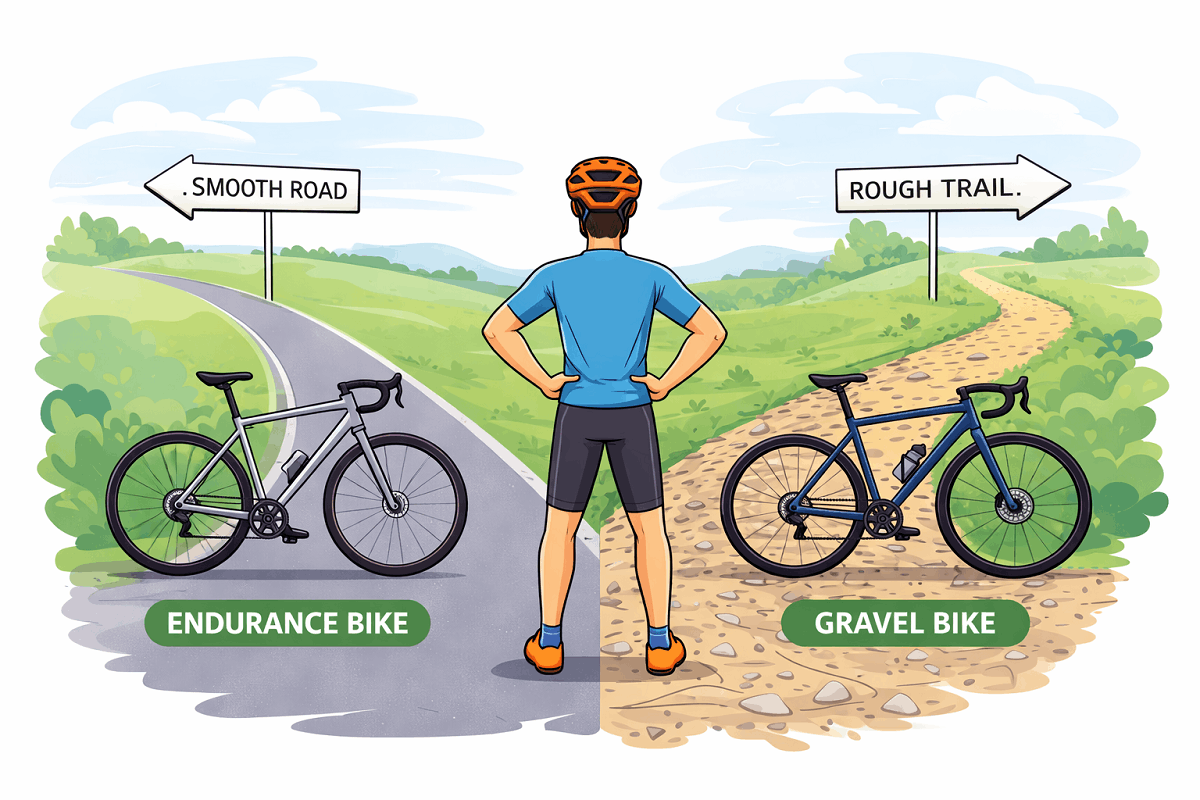
What you notice as soon as the surface changes
This is where the difference becomes obvious.
An endurance bike handles rough roads well, but there is a limit.
Once the surface gets loose or uneven, you start to feel it through the bike.
You slow down, pick your line more carefully, and stay more cautious.
A gravel bike feels calmer in the same situation.
Wider tires, lower pressures, and more stable geometry mean you can keep riding at a steady pace without constantly adjusting.
This is not about speed. It is about how relaxed you feel on the bike.
Geometry and handling feel
Endurance bikes still behave like road bikes.
They are stable, but they respond quickly and feel efficient when you are riding on smooth surfaces.
Gravel bikes are more relaxed.
Longer wheelbases and slacker angles make them feel more planted, especially on rough terrain.
The trade-off is that they can feel slightly slower to respond on the road.
You notice this most when cornering or changing direction quickly.
Tire clearance and why it matters more than you think
This is one of the biggest practical differences.
Endurance bikes typically take tires up to around 30–35mm.
That is enough for comfort on rough roads and light gravel.
Gravel bikes usually handle 40mm, 45mm, or more.
This changes how the bike rides.
Wider tires allow lower pressures, which means more grip and more comfort on uneven surfaces.
It also means you can ride surfaces that would feel harsh or unstable on an endurance bike.
Speed on the road
Endurance bikes are faster on tarmac.
The geometry, weight, and riding position are all designed for efficiency.
You can hold speed more easily and with less effort.
Gravel bikes can still be quick, especially with narrower tires, but they usually feel a bit less sharp.
You notice it when accelerating or trying to maintain higher speeds.
If most of your riding is on the road, this matters.
Comfort over longer rides
Both bikes are comfortable, but in different ways.
Endurance bikes reduce fatigue on smooth roads.
They take pressure off your body and make long rides more manageable.
Gravel bikes add another layer of comfort through tire volume and stability.
On rough surfaces, they are noticeably more forgiving.
On smooth roads, the difference is smaller.
Versatility in real riding
Gravel bikes are more versatile, but again, it shows up in specific situations.
You can leave the road without thinking twice.
You can take detours, explore new routes, and ride surfaces that would stop an endurance bike.
Endurance bikes are versatile within the road category.
They handle poor road surfaces well, but they are not designed for proper off-road riding.
Where each bike starts to feel limited
This is often what makes the decision easier.
Endurance bikes start to feel limited when:
- the road turns to loose gravel
- the surface becomes uneven or unpredictable
- you want to explore beyond paved routes
Gravel bikes start to feel less ideal when:
- you ride mostly smooth roads
- you want maximum speed and responsiveness
- you care about road bike efficiency
Who should choose an endurance bike?
- Riders who stay mostly on paved roads
- Those who want comfort without losing speed
- Long-distance road riders
- Anyone who still wants a traditional road bike feel
It is the better choice if your rides are predictable and road-focused.
Who should choose a gravel bike?
- Riders who mix road and off-road
- Those who want one bike for everything
- Anyone who values flexibility over outright speed
- Riders who explore less predictable routes
It makes more sense the more varied your riding becomes.
Can one replace the other?
A gravel bike can replace an endurance bike for many riders.
Fit narrower tires, and it performs well on the road.
It will not feel quite as sharp, but the difference is often small enough to accept.
An endurance bike can handle light gravel, but it has limits.
Once the terrain gets rough, those limits show quickly.
Useful gear and accessories
If you are still comparing, it is also worth looking at cyclocross vs gravel and types of road bikes.
Our verdict
If your riding is mostly on the road, an endurance bike is the better choice. If your rides regularly go beyond smooth tarmac, a gravel bike will make more sense.
The key is not what the bike can do. It is where you will actually ride most of the time.

I’ve spent way more time in the bike trade than anyone should reasonably want to. In that time I’ve wanted to make cycling jargon and marketing easier to cut through to help people get the bike of their dreams.
When I’m not writing about bikes, I can be seen out bikepacking on single speed bikes or teaching kids how to ride.