
Choosing between Microshift Advent vs Shimano CUES is less about picking the “better” brand and more about avoiding a drivetrain that does not match your bike. Both are budget-friendly mechanical 1x systems for gravel, mountain biking, commuting, touring and value-focused builds. Neither is a premium-race alternative, and that is fine: the useful question is whether you get the right gearing, sensible replacement costs and parts you can actually find.
There is one important catch. Advent and CUES are drivetrain families, not single groupsets. Advent 9-speed, Advent X 10-speed and CUES 9-, 10- or 11-speed parts are not interchangeable by assumption. The exact component combination matters more than the logo on the derailleur.
The short answer: choose based on the complete drivetrain
Shimano CUES is usually the safer starting choice for a new complete bike or a high-mileage utility bike. Shimano’s dealer network is broad, bike shops are likely to be familiar with it, and the CUES range gives manufacturers more structured options across different price points. That matters when you need a replacement shifter or cassette several years from now.
Microshift Advent or Advent X is usually the stronger value choice when a matched kit is meaningfully cheaper. It makes particular sense for a low-cost custom build, a budget replacement or a rider who wants straightforward mechanical shifting without paying extra for a larger ecosystem.
Do not compare brand names alone. A well-geared Advent 9-speed setup can be a better bike than an expensive CUES build with the wrong chainring and not enough low range. More sprockets are not magic beans; they mainly allow smaller jumps between gears.
| Decision point | Practical takeaway |
|---|---|
| Typical speed options | Advent is commonly 9-speed; Advent X is commonly 10-speed. CUES spans 9-, 10- and 11-speed families, depending on the components. |
| Best general fit | Advent suits budget builds and matched-kit replacements. CUES suits new bikes and long-term utility use where parts availability matters. |
| Gearing flexibility | Choose by cassette range and chainring size first. Speed count comes second. |
| Compatibility | Neither family should be mixed casually. Exact speed and component specifications matter. |
| Value priority | Advent often wins when discounted or bought as a complete kit. CUES can justify its cost through sourcing and shop familiarity. |
| Weight priority | Neither is intended as a lightweight upgrade. Pay for the gearing and serviceability, not imaginary podium points. |
Microshift Advent and Advent X: what you actually get
Microshift Advent is a mechanical 1x system generally associated with 9-speed wide-range gearing. Advent X moves to 10 speeds and uses its own component specifications. A typical build includes a flat-bar shifter, rear derailleur with a clutch, wide-range cassette, chain and a single chainring.
The clutch adds resistance to the derailleur cage as it moves. That helps reduce chain slap and limits how much the chain can bounce on rough tracks. It does not make the bike immune to poor chainline or a badly adjusted derailleur, but it is a useful feature for hardtails, gravel bikes on broken roads and other bikes that leave smooth tarmac.
The wide-range cassette supplies the climbing gear. A larger rear sprocket makes steep gradients less punishing, while the chainring determines the overall balance between climbing ability and top-end speed. For many riders, changing chainring size has a bigger practical effect than moving from nine to ten or eleven speeds.
Advent’s appeal is simplicity. Cable-operated controls are familiar, serviceable and relatively inexpensive to replace. A Microshift Advent 9-speed kit can be a sensible way to get a functioning 1x drivetrain onto a budget frame, while an Advent X 10-speed cassette can provide smaller gear steps when its overall range is similar to the 9-speed cassette being compared.
The limitations are equally practical. There are fewer ecosystem and specification choices than with Shimano, and you need to verify compatibility rather than assume every Advent-branded part belongs to the same system. An Advent shifter, Advent X derailleur and random wide-range cassette may look close enough on a product page and still make a thoroughly unhelpful combination.
Shimano CUES: why the newer ecosystem matters
Shimano CUES is the company’s recreational and value drivetrain family. It includes lines such as CUES U4000 and U6000, along with other options depending on the bike and speed level. The idea is to provide a more organized range of durable, everyday components for commuting, gravel, touring and light trail use.
Where fitted, LINKGLIDE uses a tooth and chain design intended to cope with frequent shifting and higher mileage. The priority is consistent everyday service and wear resistance rather than chasing the lowest possible component weight. That is a sensible trade for a commuter or utility bike, although it does not make every CUES part indestructible.
CUES is not one single groupset. A CUES 9-speed build and a CUES 11-speed build require different cassettes, chains and shifters. Shimano’s improved cross-compatibility applies within specified CUES speed families and component instructions; it is not permission to mix anything with a CUES label.
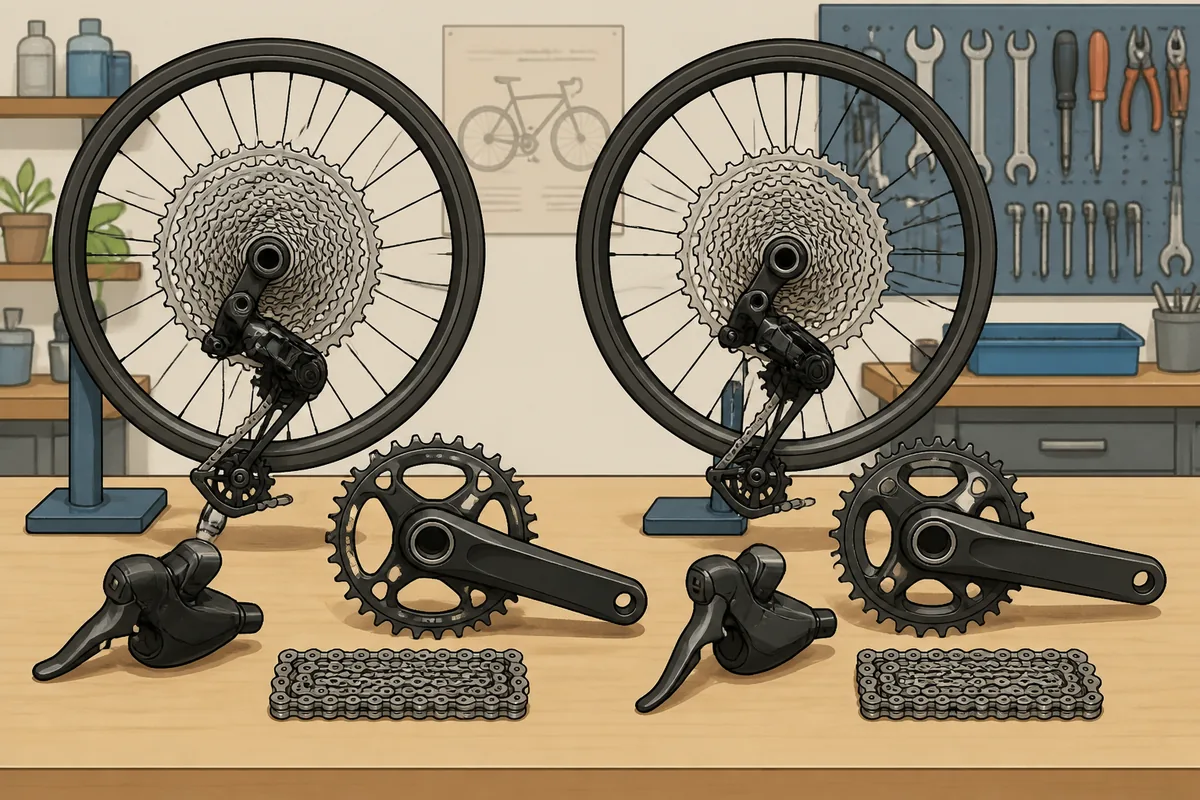
A CUES U4000 or U6000 rear derailleur can therefore be an attractive choice for a new bike, particularly when the complete build uses a compatible wide-range cassette and matching shifter. The package may cost more than a discounted Advent setup and is not automatically lighter. Its strongest argument is a more predictable ecosystem and easier future sourcing, not guaranteed faster shifting.
Gearing, shifting and rough-ground performance
Compare the useful range, not just the number printed on the cassette. A 1x drivetrain with a wide-range cassette gives you a low climbing gear and a high gear for faster roads, but the gap between those sprockets can be noticeable. More speeds reduce those jumps; they do not automatically make you faster or more durable.
For gravel and commuting, start with your actual terrain. If your routes are mostly flat, an enormous cassette may give you wide gaps without providing much benefit. If you regularly climb steep lanes, tow luggage or ride an underpowered local hill, the lowest gear deserves priority. A smaller chainring can make a bigger difference than upgrading the derailleur.
For mountain biking, prioritize the clutch derailleur, chain stability and a low gear you will genuinely use. Advent and CUES can both work well on a budget hardtail when correctly specified. A correctly geared Advent setup is preferable to a more expensive CUES drivetrain that leaves you grinding up every climb in a gear that is too tall.
Shifting quality also depends on the basics: a straight derailleur hanger, clean housing, correct cable tension and a properly adjusted limit screw. A premium label cannot compensate for a cable routed like a garden hose.
| Rider or bike use | Safer starting choice |
|---|---|
| Budget custom build | Microshift Advent or Advent X, provided you can buy the shifter, derailleur, cassette and chain as a matched system. |
| Gravel bike | Either family. Choose the chainring and cassette range for your climbs, then compare price and local availability. |
| Hardtail MTB | Either family with a clutch derailleur and suitable low gear. Do not choose by speed count alone. |
| Commuting or touring | Shimano CUES is the safer default when long-term sourcing and frequent use matter more than the lowest initial cost. |
| New complete bike | CUES is usually the easier starting point, unless the Advent-equipped bike has clearly better gearing or a substantially lower cost. |
Compatibility, maintenance and replacement costs
Before buying, match the shifter speed, derailleur capacity, cassette speed, chain type, freehub requirements and crank or chainring fit. This is the decisive checkpoint in the Microshift Advent versus Shimano CUES comparison.
A drivetrain upgrade is rarely just a rear derailleur swap. You may need a new shifter, cassette, chain, cables and housing. Depending on the cassette and wheel, you may also need a different freehub body. A crankset or chainring change can be necessary if the existing part does not provide the required fit or gearing.
Both systems use familiar cable-actuated mechanics. They benefit more from correct cable routing, regular chain replacement and accurate adjustment than from an expensive badge. If the chain is worn or the derailleur hanger is bent, replacing the whole drivetrain simply to change brands is poor value.
Shimano probably has the sourcing advantage through its dealer network, which can matter when you need a cassette or shifter quickly rather than after a long hunt through online stock lists. Advent can be cheaper when the exact parts are available, especially as a complete matched kit. Check availability in your area before choosing the theoretical bargain.
Do not replace a working drivetrain for branding alone. Upgrade when the current parts are worn, cannot provide the gearing you need, or are too expensive to replace. If the bike shifts cleanly and gives you a suitable low gear, your money may be better spent on tires, contact points or simply riding the bike.
Which should you buy for your bike?
Choose Microshift Advent for a low-cost custom build, a budget replacement or simple 9-speed 1x gearing. Advent X makes sense when you want a 10-speed system and can source the complete matched parts without mixing families.
Choose Shimano CUES for a new complete bike, a high-mileage commuter or a utility bike you expect to keep for years. The wider Shimano service ecosystem is a real advantage, even if the drivetrain is not lighter or faster on paper.
For gravel, select the chainring and cassette range first. For MTB, select the low gear and chain-management setup first. For uncertain upgrades, take the exact current drivetrain details to a bike shop, including the cassette, shifter, derailleur and freehub information. Guessing compatibility is an expensive way to discover that two black components are not, in fact, friends.
Frequently asked questions
Can Microshift Advent and Shimano CUES parts be mixed?
Do not assume they can. Match the exact shifter, derailleur, cassette, chain and crank specifications. Most swaps are safest when you use a complete matched system rather than combining random parts from both families.
Is Shimano CUES better than Microshift Advent for mountain biking?
Not automatically. CUES may be easier to source, while Advent can offer excellent budget value. The correct low gear, a clutch derailleur and good setup matter more than the product label.
Is a 10- or 11-speed drivetrain worth choosing over 9-speed?
Choose more speeds for smaller gear steps or a particular cassette range, not because the bike will automatically be faster. Nine-speed can be cheaper and easier to maintain, and it remains entirely adequate for many gravel, commuting and trail bikes.

I’ve spent way more time in the bike trade than anyone should reasonably want to. In that time I’ve wanted to make cycling jargon and marketing easier to cut through to help people get the bike of their dreams.
When I’m not writing about bikes, I can be seen out bikepacking on single speed bikes or teaching kids how to ride.