A bike wheel wobble is not always a bent wheel. The movement may come from a loose axle, a tire bead that has not seated properly, play in the hub bearings, an out-of-true rim, or damage that should not be ridden on.
Check in this order before reaching for a spoke wrench:
- Wheel seated and axle / quick release / thru-axle tight.
- Tire bead seated evenly (rim may be true while the tire wanders).
- Hub play at the axle.
- Rim true versus a bent or damaged section.
- Shop help if several spokes, cracks, or heavy brake rub remain.
Tightening spokes before identifying the cause is how a small problem becomes a lopsided wheel. Assumes you can safely lift the bike and spin the wheel – not professional repair for axle, rim, bead, braking, or multi-spoke damage.
First, stop riding and identify what is actually wobbling
Before reaching for a spoke wrench, work out which part is moving. A wheel can wobble because the complete wheel is shifting in the frame, the tire is moving on the rim, the hub has side play, or the rim itself is running off-center.
Stop riding immediately if the wheel is loose in the frame, the rim is cracked or sharply kinked, the tire bead is lifting, several spokes are broken, or the wheel rubs heavily against a brake, fork, chainstay, or seatstay. Those are not “ride it and see” faults.
Secure the bike in a repair stand, or lift it carefully so the wheel can spin freely. Release the brake quick release if necessary, particularly with rim brakes, but close and reset it before riding. Spin the wheel and watch the rim against a fixed reference such as the brake pads, frame, or a zip tie attached close to the rim. Keep fingers, loose clothing, and the zip tie away from moving spokes.
Watch the rim and tire separately. If the rim tracks straight but the tire wanders, look at the tire seating. If the rim itself moves side to side, continue with the checks below. Do not start tightening spokes until you know the wheel is actually out of true.
| What you notice | Likely cause and next step |
|---|---|
| Complete wheel moves in the frame | Loose quick release, thru-axle, or wheel nuts. Stop riding and reinstall it correctly. |
| Tire moves, but rim runs straight | Uneven tire bead, trapped tube, or damaged tire. Deflate and inspect before riding. |
| Rim rocks side to side at the axle | Hub or bearing play. Stop treating it as a truing problem; service may be needed. |
| Rim moves side to side at one section | Lateral out-of-true wheel, loose or broken spoke, or impact damage. Assess before adjusting spokes. |
| Wheel rises and falls once per revolution | Radial hop or dip, sometimes from impact or uneven spoke tension. A mechanic may need to correct it. |
| Sharp bend, crack, or repeated spoke failures | Structural damage or a compromised wheel. Do not ride; replacement or specialist repair is likely. |
Check the wheel is installed correctly
The safest first check costs nothing: make sure the wheel is properly secured in the dropouts. A wheel sitting crooked can look like an out-of-true rim, especially after fixing a puncture, transporting the bike, or removing the wheel from a rack.
For a quick-release wheel, the lever should close firmly rather than flop shut with no resistance. A properly adjusted lever leaves a noticeable imprint in your palm when you close it. The lever should also sit in a safe position, not point forward where it can catch on something.
For a thru-axle, thread it fully into the frame or fork and tighten it according to the bike manufacturer’s instructions. Do not confuse a lever that is technically closed with an axle that is actually tight. On nutted wheels, check that both nuts are seated and secure.
Remove the wheel, check the dropouts and axle ends for dirt or damage, then reinstall it. Make sure the axle is fully seated before securing it. Spin the wheel again. If the apparent wobble has disappeared, you have found the problem.
This is the best starting point because a loose wheel is more serious than a modest truing issue. If it still moves after correct installation, keep diagnosing rather than assuming the rim needs attention.
Rule out tire seating and tire damage
An uneven tire bead can create a convincing wobble even when the rim is straight. This often appears as repeating side-to-side movement or a hop as the tire rotates. The rubber is misbehaving; the spokes are innocent for once.
Look for the molded line around the tire sidewall, close to the rim edge. It should sit at a consistent distance from the rim all the way around, on both sides. If the line disappears into the rim at one point or sits farther out elsewhere, the bead has not seated evenly.
Common causes include a tire installed partly under the bead, low inflation after fitting, a trapped inner tube, a damaged tire casing, or a tire that has been ridden flat. Inspect for cuts, bulges, exposed casing, and flattened or distorted sections.
To correct a bead that is not seated, deflate the tire, remove enough of the bead to inspect the tube and rim, and check that the tube is not trapped beneath the bead. A small amount of appropriate soapy water can help the bead slide into position. Never use a flammable product as tire lubricant.
Inflate gradually, checking both bead lines as the pressure rises. Follow the tire’s pressure range and stop if the bead still lifts or the tire develops a bulge. Replace a damaged tire rather than forcing it into service.
Replacing or reseating the tire is the sensible fix when the rim tracks straight. Truing a wheel to solve a problem caused by rubber is expensive wheel-themed gardening.
Test for hub play and worn bearings
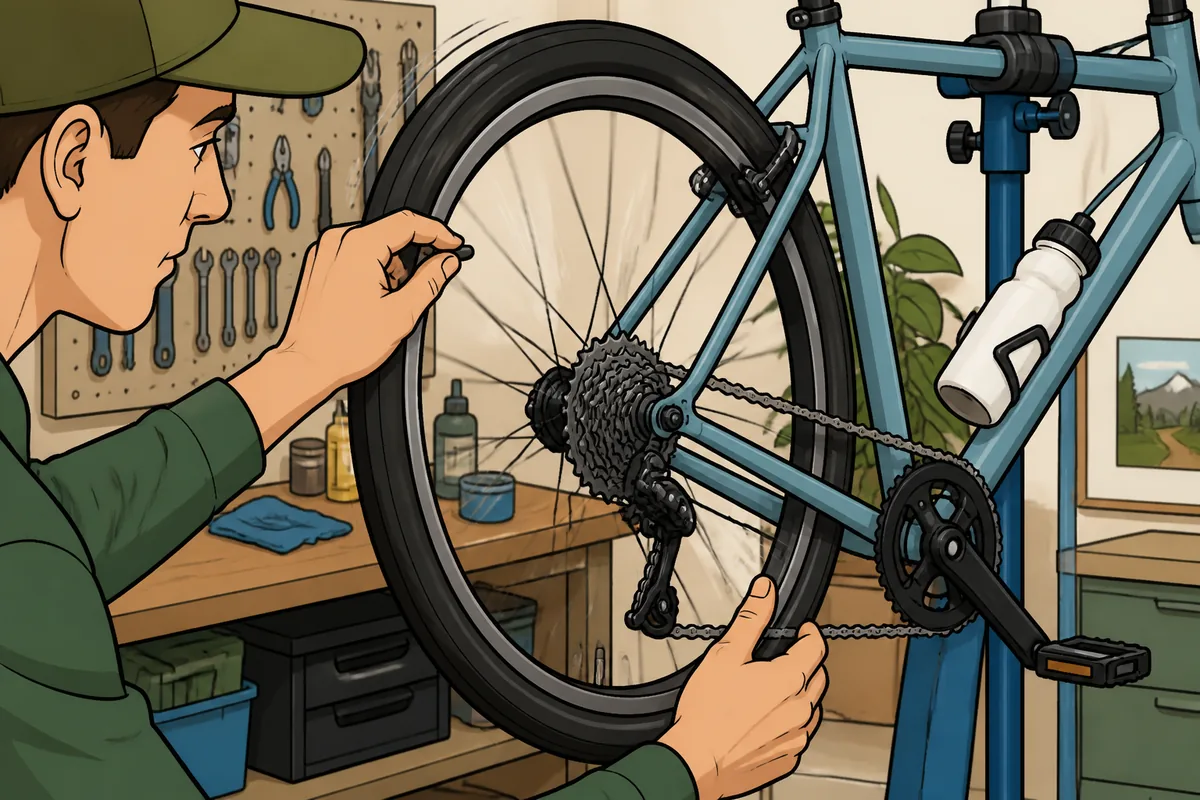
Hub play is felt at the axle. It is not simply the rim drifting slightly as it spins. A wheel with loose bearings may look secure but rock from side to side when you load it by hand.
With the wheel secured in the frame or fork, hold the tire or rim and gently push it from side to side. Feel for a distinct click or movement at the hub. Do not mistake normal tire or frame flex for bearing play; the movement should feel like looseness around the axle.
Spin the wheel and listen and feel for roughness. Slight bearing drag is not automatically a fault, but grinding, gritty rotation, a notchy feel, or clear side play needs attention. Check that the movement is not actually coming from a loose axle or poorly installed wheel.
Cup-and-cone hubs may need bearing adjustment, fresh grease, or replacement bearing parts. Cartridge-bearing hubs usually need a new cartridge when worn. The correct repair depends on the hub design, and neither fault is fixed by tightening spokes.
If there is clear hub play or rough bearing movement, use a mechanic unless you already understand the hub’s adjustment system. Over-tightening an adjustable hub can damage the bearings even when the rim looks straight.
Tell an out-of-true wheel from a bent rim
A wheel is laterally out of true when the rim moves from side to side as it rotates. It is radially out of true when the rim rises and falls, creating a hop or dip. A wheel can have one problem or both.
With the wheel spinning, move a brake pad or zip tie close to the rim as a visual reference. Note where the rim comes closest and whether the movement is gradual or a sharp kink. This helps with diagnosis, but it is not a substitute for a proper truing setup or spoke-tension measurement.
Uneven spoke tension, a broken spoke, an impact, an overloaded rim, or a poor previous repair can make a wheel run out of true. A small, smooth deviation may be corrected by balancing spoke tension. A sharply bent rim, crease, crack, or flat section is different.
An out-of-true rim can often be corrected with careful spoke adjustments. A sharply kinked or cracked rim usually needs replacement. Forcing badly bent metal straight can leave unreliable spoke tension, hidden damage, and a wheel that goes out again soon after repair.
Disc-brake wheels can sometimes tolerate a small amount of lateral movement without brake rub, but that does not make every wobble harmless. Rim-brake wheels have less clearance because the brake pads provide an immediate warning. There is no universal safe wobble limit: rim design, tire clearance, brake type, and frame or fork clearance all matter.
For background on wheel trueness and spoke tension, see the Park Tool wheel truing guides and Sheldon Brown’s wheel-truing guidance.
What you can fix at home and when to use a shop
Most riders can safely begin with wheel removal and reinstallation, checking axle security, inspecting tire seating, and replacing a damaged tube or tire. Those checks isolate common causes without disturbing spoke tension.
Spoke adjustment is less forgiving than it appears. Turning the wrong nipple, tightening one spoke too far, or correcting only the visible section can worsen the wobble and create uneven tension elsewhere. A spoke wrench is useful, but it is not a truing system.
If you want to learn wheel truing, start with a truing stand, learn how spoke tension moves the rim, and practice on a wheel that is not your only means of getting home. A mechanic’s inspection is usually better value than replacing spokes or a rim after a random adjustment goes wrong.
Use a shop for a wheel that will not sit straight in the frame, has clear hub play, rubs badly, contains multiple broken spokes, or remains out of true after careful adjustment. Also stop riding for any cracked rim, sharply kinked rim, lifting tire bead, severe rotor interference, or damaged axle hardware.
If a spoke has failed, follow the separate guide on how to fix a broken spoke. A single broken spoke does not always mean the wheel is finished, but continuing to ride can overload the remaining spokes and turn a small repair into a wheel rebuild.
Bike wheel wobble FAQs
Can I ride a bike with a slightly wobbly wheel?
Only after checking that the wheel is securely installed, the tire is seated, the rim is undamaged, and the wobble is minor. Stop if the wheel moves in the frame, rubs badly, or shows structural damage. There is no single safe wobble measurement that applies to every wheel and brake setup.
How do I know if the tire or rim is causing the wobble?
Watch the rim against a fixed reference while spinning the wheel, then inspect the tire’s bead line. If the rim tracks straight but the tire moves, reseat or replace the tire. If both move together, continue checking the hub and rim.
Should I tighten the spokes to fix a bike wheel wobble?
Not until you have confirmed that the rim is out of true. Spoke adjustment is precise work, and tightening the wrong spokes can make the wheel less reliable. Start with installation, tire seating, and hub play; use a truing stand or a shop for the spoke work.
The practical order is simple: secure the wheel, inspect the tire, check the hub, then assess rim trueness and damage. If it is loose, badly rubbing, cracked, or repeatedly failing, do not ride it while hoping the wobble develops better manners.

I’ve spent way more time in the bike trade than anyone should reasonably want to. In that time I’ve wanted to make cycling jargon and marketing easier to cut through to help people get the bike of their dreams.
When I’m not writing about bikes, I can be seen out bikepacking on single speed bikes or teaching kids how to ride.