Choosing the right bike handlebar width guide starting point is less about copying a professional’s bike and more about keeping your hands, shoulders and steering under control. A narrower bar can reduce frontal area and suit a smaller rider, while a wider bar gives you more leverage and breathing room. Neither is automatically faster or more comfortable.
This guide assumes you already have a bike that fits reasonably well. Handlebar width is only one part of fit. Persistent hand, neck, shoulder or back pain should be assessed by a qualified bike fitter or healthcare professional rather than solved through repeated parts swapping.
How handlebar width changes the way your bike rides
Handlebar width affects both your body position and the way the bike responds. On a road bike, narrower bars can make the cockpit feel compact and may reduce your frontal area slightly. They can also suit smaller frames and riders with narrower shoulders.
Go too narrow, though, and your upper body may feel cramped. Your hands can end up unnaturally close together, breathing may feel restricted, and the steering can become more sensitive. On drop bars, very narrow bars may also leave less room around the brake hoods and make the drops awkward to use.
Wider bars increase leverage. That matters when you are standing on the pedals, steering through loose ground or holding a line on a steep descent. The tradeoff is extra frontal area on a road bike, more effort to move the bar through tight spaces, and possible shoulder strain if the width does not suit you.
Your height is a poor measurement on its own. Shoulder structure, torso position, flexibility, riding discipline and the terrain you ride matter more. Road drop-bar width and MTB flat-bar width also cannot be compared directly: they are different cockpit designs with different control positions and steering demands.
The sensible default is to begin near a body-based fit range, then adjust for control and comfort. Chasing an aerodynamic number or a fashionable width before checking those basics is how an inexpensive handlebar turns into an expensive detour.
Bike handlebar width chart by discipline
The ranges below are practical starting points, not universal prescriptions. Manufacturers do not always measure handlebars in the same place, so check the specification before comparing two bars.
| Bike type | Practical starting range and fit note |
|---|---|
| Road drop bar | 36-44 cm. Around 38-42 cm suits many general road riders; smaller riders often consider 36-38 cm. |
| Gravel drop bar | 40-46 cm at the tops. Flared drops can be substantially wider than the hood or top measurement. |
| Cross-country MTB | 700-760 mm is a useful starting range, adjusted for rider size, tight trails and steering preference. |
| Trail MTB | 740-800 mm is common as a starting point where leverage and stability matter more than squeezing through narrow gaps. |
| Enduro/downhill MTB | 760-800 mm can provide useful leverage and stability, provided the rider and terrain justify it. |
Road and gravel bars are normally described in centimetres, while flat MTB bars use millimetres. A road bar listed as 40 cm might be measured centre-to-centre at the drops or outside-to-outside at the hoods, depending on the manufacturer. Those figures are not interchangeable.
Usable width can also change with bar shape. Flare makes the drops wider than the tops, backsweep changes the angle of your hands on a flat bar, and lever position changes where your hands actually sit. Cut-down marks on an MTB bar are useful, but they do not replace checking the manufacturer’s instructions.
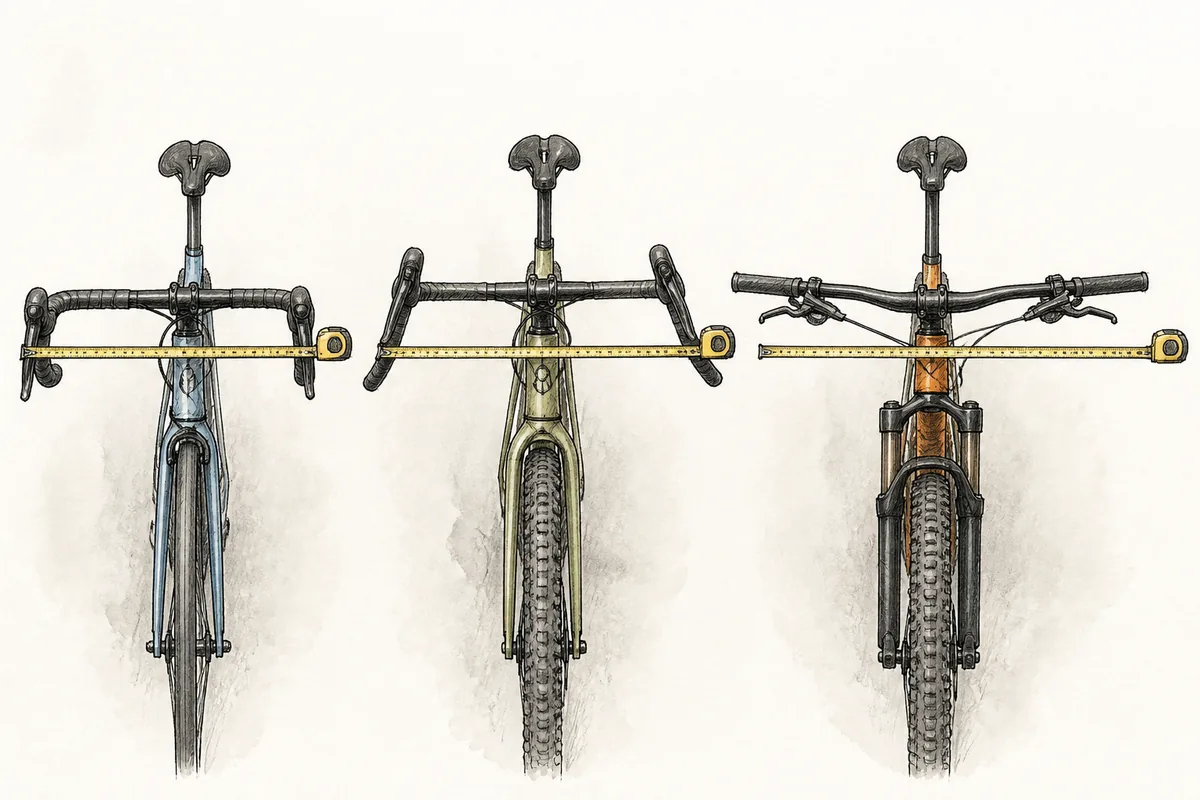
Choosing road and gravel drop-bar width
For a road drop bar, use your shoulder width as a reference rather than an exact formula. The bar should allow a natural upper-body position, with your elbows relaxed and your hands comfortably aligned with your shoulders. If you have to force your arms inward or reach excessively outward, the nominal width is probably wrong for your position.
For general road riding, a conventional compact bar near your sensible fit range is the safest choice. A 40 cm compact road bar is a reasonable starting point for many riders, but it is not a magic number. Smaller riders may prefer 36 or 38 cm, while broader riders or those who value a more open position may need 42 or 44 cm.
Narrower bars can help a rider seeking a compact racing position, especially on smooth roads. The aerodynamic benefit is real in principle, but it is often overstated relative to the effect of your clothing, body position and speed. Do not buy an ultra-narrow bar purely because the number looks fast. If it makes the bike uncomfortable or compromises control, the saving is mostly theoretical.
Gravel changes the priority. You need reliable access to the brake levers, stable steering on loose surfaces and enough leverage for rough descents. A flared gravel bar can keep the tops and hoods relatively moderate while widening the drops, giving you a more planted position when the road becomes an argument with physics.
Modest flare is usually more useful than simply buying the widest gravel bar available. Too much flare can make the drops uncomfortable, complicate handlebar-bag mounting and alter lever reach. Check that your brake levers and cables or hoses are compatible with the bar’s shape before buying.
Choosing MTB handlebar width and when to cut it
MTB bars are wider because mountain bikes need leverage and steering stability. When you are standing, moving your body around the bike or correcting a line on rough ground, extra width gives you more control over the front wheel.
Cross-country riders commonly use the narrower end of the range, particularly on smaller bikes or tight woodland trails. Trail and enduro riders generally benefit from more width when the terrain is steep, rough and open enough to use it. Downhill setups can also be wide, but the correct number still depends on your body and the bike’s cockpit.
Do not ignore the practical constraints. A bar that is excellent on an open trail may be irritating between trees. Excess width can overload your shoulders, make tight steering feel slow and leave your elbows unable to stay relaxed. Many beginners overbuy width because a wide bar looks capable. Start wide enough for leverage, not as wide as the catalogue permits.
Stem length, rise, backsweep and control placement all affect the result. A wide bar combined with a long stem can make the cockpit feel stretched, while excessive backsweep may change wrist comfort and steering response. Width is not a cure for a reach problem.
If the bar feels too wide, cut it in small steps, such as 5-10 mm per side. Mark the original width first, remove equal amounts from both sides and reposition the controls symmetrically. Carbon bars require the manufacturer’s specific cutting method and minimum-width guidance. Alloy bars still need clean, even cuts and properly secured controls.
Signs your handlebar is too wide or too narrow
A bar that is too wide may produce shoulder or upper-back strain, prevent your elbows from relaxing, and make narrow gaps unnecessarily stressful. On a road bike, your hands may feel excessively spread. On an MTB, the steering can feel heavy or slow in tight terrain.
A bar that is too narrow can create a cramped breathing position and make standing steering feel unstable. MTB riders may notice reduced leverage, while road riders may struggle to access the brake levers or find a comfortable position in the drops.
These symptoms are not always caused by width. Excessive reach, poorly positioned hoods, incorrect bar rotation, saddle setback or an unsuitable stem can create similar discomfort. Change one variable at a time and use familiar roads or trails to judge the effect.
Numbness, persistent pain or weakness is not a normal fit target. Stop treating the parts bin as a diagnostic tool and seek professional assessment.
How to measure, compare and buy the right width
If your current bar feels comfortable, use it as the baseline. Measure from the points the manufacturer uses, or look up the model’s specification. On a drop bar, identify whether the quoted width is centre-to-centre or outside-to-outside. On a flat bar, measure the overall width before removing grips and controls.
Before buying, check more than the headline width. Confirm the clamp diameter, rise, sweep, reach, drop, flare and the space available for your brake levers, shifters, cables, hoses and accessories. A 780 mm alloy MTB bar with cut marks may be a sensible purchase if you want adjustability. A compact road drop bar or flared gravel drop bar may suit a different job entirely.
Do not replace a handlebar just because a new model has a fashionable width. If your current position is comfortable and controlled, there may be no useful upgrade. When you do have a clear reason to change, make the smallest change that addresses it. For a broader look at road options, see our guide to best road bike handlebars.
Frequently asked questions
Should handlebar width match your shoulder width?
Shoulder width is a useful starting reference for drop bars, but terrain, riding position, control access and personal comfort also matter. It is not an exact one-number formula.
Are wider handlebars better for mountain biking?
Wider MTB bars usually add leverage and stability, but they are not automatically better. Excess width can strain your shoulders, slow steering and be impractical on tight trails.
Can I cut my MTB handlebars narrower?
Usually, yes, if the bar manufacturer allows it. Cut a small amount from each side, keep the controls symmetrical and follow the bar’s minimum-width and cutting instructions.
Use the chart as a starting point, not a verdict. For road riding, choose a conventional bar close to your sensible fit range. For gravel, prioritize control and modest flare. For MTB, begin with enough width for leverage and trim gradually if comfort or trail clearance demands it.

I’ve spent way more time in the bike trade than anyone should reasonably want to. In that time I’ve wanted to make cycling jargon and marketing easier to cut through to help people get the bike of their dreams.
When I’m not writing about bikes, I can be seen out bikepacking on single speed bikes or teaching kids how to ride.