Gravel riding sits in an awkward middle ground.
It is not quite road, not quite mountain biking, and that means your drivetrain has to deal with a bit of everything. Long steady efforts, sudden climbs, loose surfaces, and rough sections where things start bouncing around.
That is exactly where Shimano GRX and SRAM Apex come in.
They are both aimed at riders who want a capable gravel setup without going into higher-end pricing, but they take slightly different approaches to solving the same problem.
You can ride either for years without issues. The difference is in how they feel and how they behave when things get rough or when the ride gets long.
What Shimano GRX is trying to do
GRX is Shimano’s first proper attempt at a dedicated gravel groupset.
It is not just a tweaked road groupset. Shimano changed ergonomics, gearing options, and even lever shape to suit rough terrain.
- Available in both 1x and 2x setups
- Designed for better control on uneven surfaces
- Smoother shifting under load
The key thing with GRX is that it still feels very “Shimano.”
Everything is smooth, predictable, and easy to live with.
What SRAM Apex is trying to do
Apex takes a simpler route.
SRAM leans heavily into 1x drivetrains and reduces complexity wherever possible.
- Primarily 1x focused
- Wide-range cassettes
- Fewer moving parts overall
The idea is straightforward.
Fewer parts means fewer things to go wrong, especially when you are riding rough terrain or in bad conditions.
It is not about refinement as much as it is about reliability and simplicity.
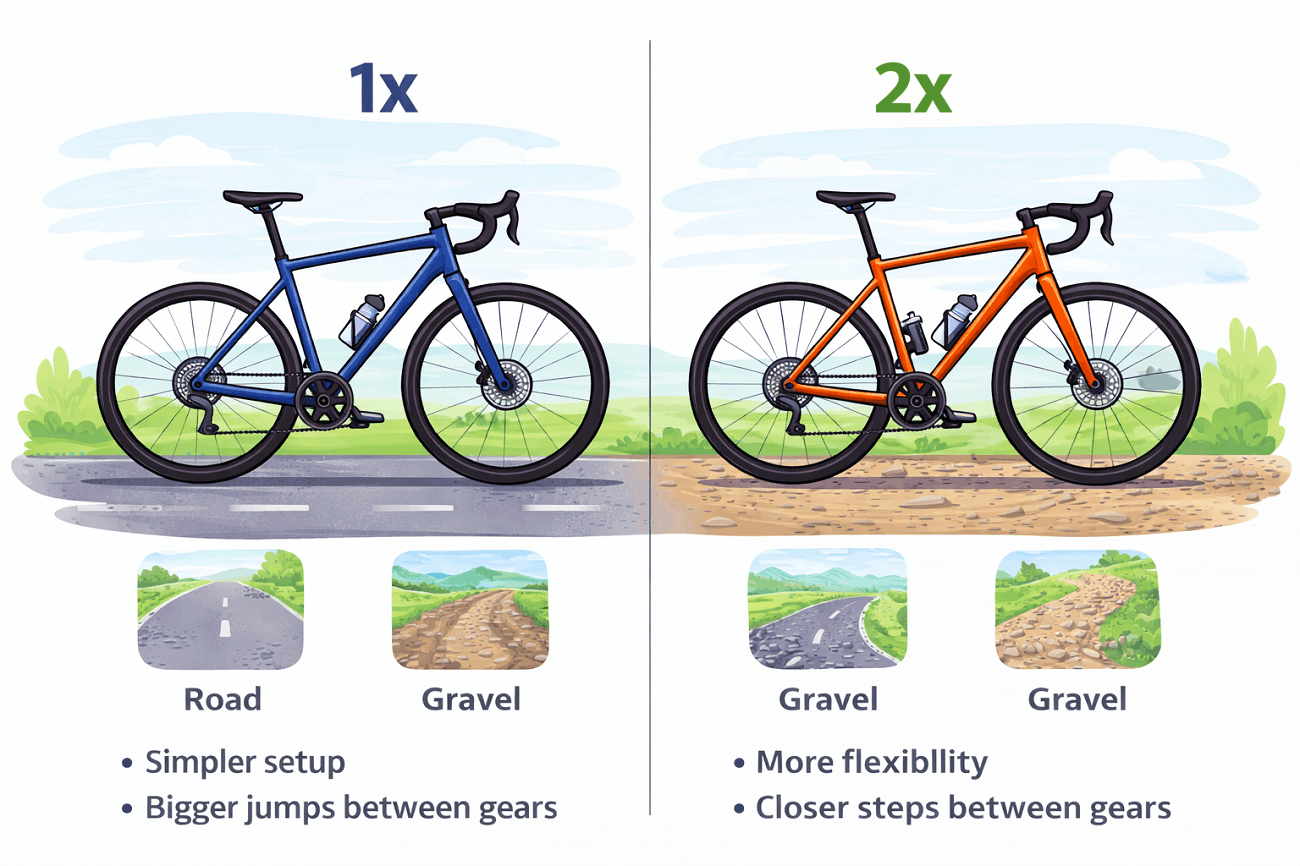
1x vs 2x in real riding
This is where the choice often gets made.
On paper, 1x looks cleaner. In practice, it changes how the bike feels quite a bit.
With a 1x setup:
- You do not think about front shifting
- You get larger gaps between gears
- You simplify the whole drivetrain
With a 2x setup:
- You get tighter gear spacing
- You can hold a more consistent cadence
- You have more flexibility on mixed terrain
On long road sections, 2x feels better.
On rough gravel or stop-start riding, 1x often feels easier to deal with.
If you want a deeper breakdown, we covered this in 1x vs 2x drivetrains.
Shifting feel and control
This is something you notice within the first few rides.
GRX shifting is lighter and more fluid. It feels like it glides between gears.
Apex is more direct. You feel each shift more clearly.
Neither is wrong, but they suit different preferences.
If you like a quieter, smoother ride, GRX tends to feel better.
If you like a bit more feedback, Apex has that mechanical feel.
Chain stability on rough terrain
Both systems use clutch derailleurs to control chain movement.
This matters more than most people expect.
Without a clutch, the chain can bounce, slap the frame, and even drop on rough terrain.
GRX has a very consistent clutch system that you can adjust.
Apex also handles this well, but the overall system is a bit more “set and forget.”
In real riding, both are reliable, but GRX feels slightly more refined when things get rough.
Braking feel
Hydraulic disc brakes come standard with both.
GRX brakes tend to have a softer initial bite and a more progressive feel.
Apex brakes feel firmer and more immediate.
This is noticeable on long descents or when riding in loose conditions.
Some riders prefer Shimano’s modulation. Others prefer SRAM’s more direct feel.
Gear range and how it feels on climbs
SRAM Apex 1x setups usually give you a very wide range.
That helps on steep climbs, especially when the surface is loose.
The trade-off is bigger jumps between gears.
GRX 2x setups give you a similar overall range but with smaller steps between gears.
On steady climbs, that makes it easier to stay in rhythm.
This becomes more noticeable the longer the climb is.
Maintenance in the real world
This is where Apex starts to make a strong case.
Fewer parts means:
- Less adjustment
- Fewer cables or components to wear out
- Simpler setup overall
GRX 2x setups require more attention, especially the front derailleur.
It is not difficult, but it is another thing to keep dialed in.
If you ride in mud, rain, or just want something low maintenance, Apex has an advantage here.
Which one feels better over time?
This is where things become clearer.
On shorter rides, the difference is small.
On longer rides, especially mixed terrain, the personality of each system comes through.
GRX feels smoother, more controlled, and slightly more “road-like.”
Apex feels simpler, tougher, and easier to live with when conditions are not perfect.
Neither one limits you. They just shape how the ride feels.
Who should choose Shimano GRX?
- Riders doing a mix of road and gravel
- Those who prefer smoother shifting
- Anyone who wants tighter gear spacing
- Long-distance riders
GRX suits riders who still want that road bike feel, just with more capability.
Who should choose SRAM Apex?
- Riders focused on gravel and rough terrain
- Those who prefer a simple 1x setup
- Anyone who wants less maintenance
- Riders who like a more direct shifting feel
Apex suits riders who want fewer decisions and fewer moving parts.
Useful components and upgrades
You can also compare further in our GRX review and Apex vs Shimano 105.
Our verdict
Shimano GRX is the more refined option.
SRAM Apex is the simpler, more stripped-back option.
If your riding leans toward longer distances and smoother terrain, GRX makes more sense.
If you want something robust, simple, and built for rougher riding, Apex is a very solid choice.
Both will do the job well. It just depends on how you want the bike to feel when you are out riding.

I’ve spent way more time in the bike trade than anyone should reasonably want to. In that time I’ve wanted to make cycling jargon and marketing easier to cut through to help people get the bike of their dreams.
When I’m not writing about bikes, I can be seen out bikepacking on single speed bikes or teaching kids how to ride.