Buying men’s cycling shorts is less complicated than the marketing makes it. You do not need the thickest chamois, the most aggressive compression or the most expensive logo. You need shorts that stay in place, manage sweat and reduce rubbing for the way you ride.
Covers close-fitting padded cycling shorts, bib shorts and waist shorts – not general gym shorts, downhill protective shorts or learning to ride.
What cycling shorts should do
Cycling shorts have three practical jobs: reducing friction between your skin, clothing and saddle; moving sweat away from your body; and providing targeted support where you contact the saddle.
Ordinary loose gym shorts are usually a poor substitute. Their seams can sit in the wrong place, loose fabric can bunch as you pedal, and pockets may press against you or catch on the saddle. Cycling shorts are cut for a bent-over riding position rather than standing around.
The key buying principle is simple: fit and pad position matter more than maximum padding thickness. A bulky pad that shifts is not an upgrade. It is just more material in the wrong place.
Waist shorts use an elastic waistband. Bib shorts use shoulder straps, allowing the main body to sit without a tight waistband. Both designs work; your ride duration and need for easy bathroom access should decide between them.
Cycling shorts fit: tight, supportive and not restrictive
Good cycling shorts should sit close to your body at the waist, hips and thighs. The fabric should be smooth, without large wrinkles, sagging panels or loose pockets of material. They should feel supportive when you bend into your riding position, not just when standing upright.
Try them on while standing, then lean forward as if holding the bars. The chamois should remain aligned with the area contacting the saddle. If it pulls backward, folds underneath you or moves from side to side, the size or cut is wrong.
Leg grippers should hold the hems in place without digging in. Some tension is useful; numbness, pinching or a pronounced indentation is not. Compression can reduce movement, but excessive tightness does not make you faster and becomes unpleasant on longer rides.
Do not automatically size up because the shorts feel snug when first pulled on. Cycling shorts are meant to stretch around your body, and a loose pair may sag once you start pedaling. Use the manufacturer’s waist and hip measurements, and buy from somewhere with a sensible return policy. Sizing varies considerably between brands.
Check for these warning signs:
- The waistband rolls over when you lean forward.
- The leg hems ride up during movement.
- The fabric becomes obviously transparent when stretched.
- The chamois shifts or wrinkles.
- The waistband or straps restrict your movement.
| Check | What good looks like |
|---|---|
| Waistband | Stays flat without rolling, slipping or digging in. |
| Chamois position | Remains aligned with the saddle contact area in a riding position. |
| Leg grippers | Keep the hems down without pinching or irritating your skin. |
| Seams | Flat, smooth and away from high-friction areas. |
| Stretch | Allows pedaling without sagging or restricting movement. |
| Transparency | Fabric remains opaque when you bend and pedal. |
| Sizing | Close-fitting when standing and stable when bent over the bars. |
Bib shorts or waist shorts?
Bib shorts are the safest default for longer road rides. Their straps hold the shorts and chamois in place without relying on a tight waistband. That usually means less waistband pressure and fewer problems with the shorts working down as you ride.
The straps should lie flat over your shoulders without pulling at your neck. The upper section needs to fit your torso as well as the shorts fit your legs. If the shorts are too small, the straps can pull uncomfortably; if they are too large, the chamois may not stay stable.
Waist shorts remain the practical choice for short commutes, quick recreational rides and anyone who values simple bathroom access. They are also easier to put on beneath casual clothing. Bib shorts are not automatically better if you dislike straps or spend more time changing clothes than riding. Convenience is a real feature, even if it does not appear in a wind-tunnel chart.
Cycling short padding: what the chamois actually changes
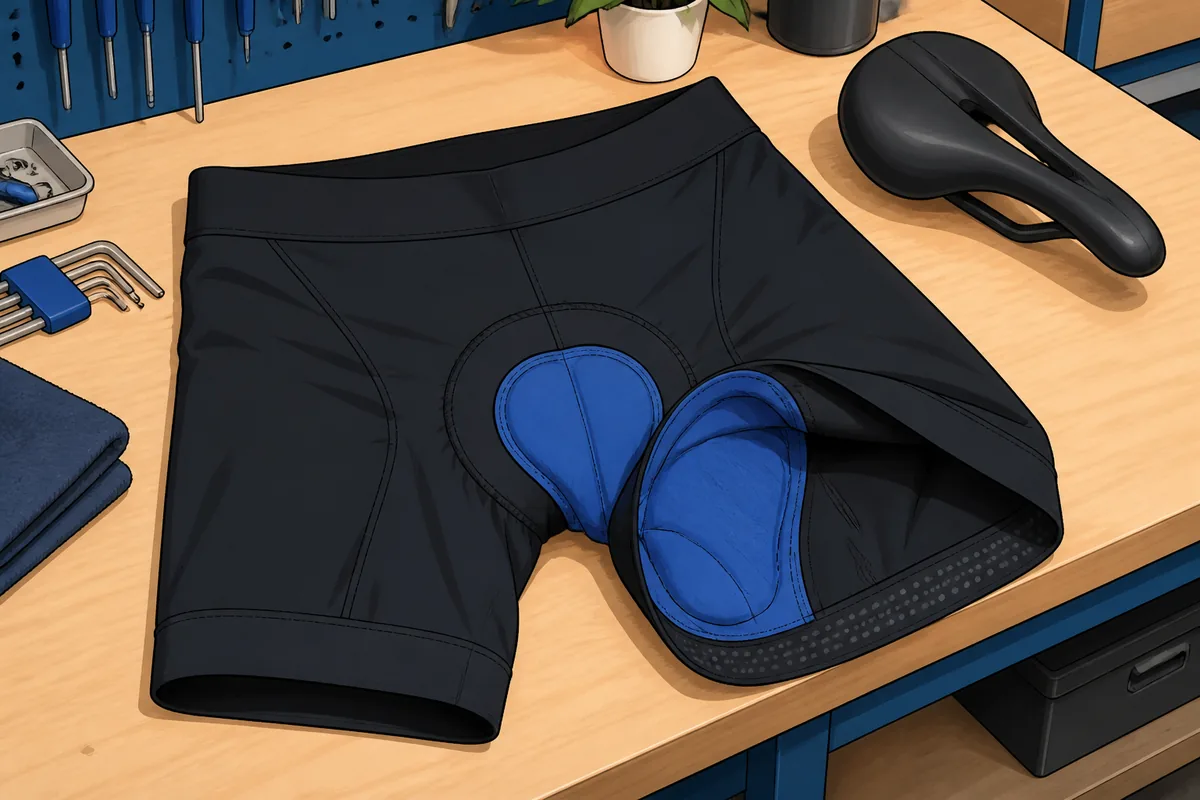
The chamois uses shaped sections with different densities and thicknesses. Its purpose is to distribute pressure, reduce direct seam contact and limit movement between your skin and the saddle. A well-shaped pad usually has more support where you need it and thinner edges where extra bulk would be noticeable.
Thicker does not automatically mean more comfortable. Excessive padding can bunch, retain moisture and feel awkward while pedaling. It can also create the false impression that a saddle problem has been solved. Padding cannot correct an unsuitable saddle, poor position or shorts that do not fit.
For short rides and indoor training, a moderate, flexible pad is generally enough. Indoor sessions can be particularly sweaty, so breathable, fast-drying fabric may matter more than extra thickness. For longer road rides, look for a stable, well-shaped pad that supports your position without feeling stiff or bulky.
Men’s and women’s pads are shaped differently around the anatomy, so a men’s-specific design is normally the sensible starting point for male riders. It is not a guarantee of fit: the cut and your position on the bike still matter.
If discomfort or chafing persists, stop and reassess rather than assuming you need a thicker pad. Saddle setup, riding position, sweat, ride duration and clothing fit can all contribute.
Fabrics, inseam length and useful features
Most cycling shorts use nylon or polyester blended with elastane. The synthetic fibers provide durability and moisture management, while elastane supplies the stretch needed for pedaling. Four-way stretch is useful because the fabric must move with your legs without becoming loose.
- Shorter inseams: cooler and less restrictive, but with more exposed skin.
- Mid-length inseams: a sensible all-round choice for many road riders.
- Longer inseams: offer more coverage and modesty, but can be warmer and more noticeable around the knee.
Flatlock seams and a broad waistband are genuine comfort upgrades. Silicone leg grippers can prevent hems from climbing, provided they are soft and remain effective after washing. Reflective details and UPF-rated fabric can be useful for specific conditions, but they are not reasons to ignore fit.
For most riders, breathable fabric and a pad that dries reasonably quickly matter more than decorative branding, extreme compression or aerodynamic claims. Cheap shorts often reveal their compromises quickly: rough seams, narrow elastic, unstable pads, grippers that lose their hold and pads with hard edges or inconsistent density.
How to buy the right pair for your riding
Start with four questions: how long do you ride, how bent-over is your riding position, will you use the shorts indoors or outdoors, and do you prefer bib straps or a waistband? Then spend your budget on reliable construction and fit rather than marginal compression or an aero claim.
| Riding use | Practical starting choice |
|---|---|
| Short commutes | Entry-level padded waist shorts for easy changes. |
| Rides of roughly 1-2 hours | A correctly sized waist short or bib with a moderate, flexible chamois. |
| Longer road rides | Bib shorts with a stable, well-shaped pad and comfortable straps. |
| Indoor training | Breathable shorts with a moderate pad and fast-drying fabric. |
| Easy bathroom access | Waist shorts are usually more practical than bibs. |
Entry-level padded waist shorts, Decathlon Van Rysel bib shorts and Pearl Izumi Quest bib shorts are useful types to compare, not universal winners. A well-fitting mid-priced pair is usually a better purchase than an expensive short that moves or chafes.
One versatile pair is enough for occasional riding. A second pair becomes worthwhile if you commute regularly, train several times each week or need clean shorts while another pair is drying. Wash shorts promptly, follow the care label and avoid fabric softener. Replace them when the pad has permanently compressed, the fabric has become thin or the waistband and grippers no longer recover.
Most beginners overbuy compression, premium branding and claimed aerodynamic gains before solving sizing, saddle position and basic fabric comfort. The safest starting choice for a new road rider is a correctly sized men’s bib short with a moderate, flexible chamois. Choose waist shorts instead when convenience is the priority.

I’ve spent way more time in the bike trade than anyone should reasonably want to. In that time I’ve wanted to make cycling jargon and marketing easier to cut through to help people get the bike of their dreams.
When I’m not writing about bikes, I can be seen out bikepacking on single speed bikes or teaching kids how to ride.