Do not buy cycling shoes by your trainer size. Measure both feet in millimetres, use the larger length, then convert with the brand’s own EU / UK / US chart – the table below is only a rough starting conversion.
After the number, judge fit: secure heel, enough toe-box width, and no hot spots through the upper. Covers road, gravel, mountain bike and indoor shoes – not cleat setup or medical foot issues.
A correctly fitted cycling shoe should feel: snug through the midfoot, locked at the heel when you pull up, with toes free to wiggle slightly – not numb, not floating.
How to use a cycling shoe size chart
Most cycling shoe charts start with foot length in millimetres or centimetres, then convert that measurement into EU, UK and US sizes. Cycling brands commonly use EU sizing, but the same nominal size can vary noticeably between manufacturers and models. A Shimano RC road shoe and an XC-style mountain bike shoe may not fit the same way even if both carry the same number.
Use the brand’s own chart as the authority. The general reference below is only a rough guide, not a universal conversion table. Check whether the listing uses men’s, women’s or unisex sizing, too. US women’s sizes generally follow a different scale from US men’s or unisex sizes.
| Foot length | Approximate EU / UK / US men’s or unisex size |
|---|---|
| 240-245 mm | EU 38-39 / UK 5-5.5 / US 6-6.5 |
| 250-255 mm | EU 40-41 / UK 6.5-7 / US 7.5-8 |
| 260-265 mm | EU 42 / UK 8 / US 8.5-9 |
| 270-275 mm | EU 43-44 / UK 9-9.5 / US 9.5-10.5 |
| 280-285 mm | EU 45 / UK 10.5 / US 11 |
| 290-295 mm | EU 46-47 / UK 11.5-12 / US 12-13 |
These values are approximate and brand-specific. The manufacturer’s chart overrides this table, and US women’s sizing may differ. If a brand publishes a foot-length range for each size, use that rather than converting from a regular shoe size.
Do not add a large amount of extra length because cycling shoes should feel close-fitting. Your toes should not be jammed against the front, but your foot should not slide forward and back inside the shoe. Extra room that seems harmless while standing can become annoying movement when you are pedalling.
How to measure your feet for cycling shoes
Measure your feet at home before looking at regional size conversions. You need a piece of paper, a pen and a floor ruler or tape measure. A ruler with a clear millimetre scale is preferable, since small differences matter more than the label on your everyday shoes.
- Put the paper on a hard floor and stand on it with your normal cycling socks.
- Keep your weight evenly distributed, then mark the back of your heel and the end of your longest toe.
- Measure the distance between those marks in millimetres or centimetres.
- Measure across the broadest part of the foot for width.
- Repeat for the other foot and record the left-versus-right difference.
Standing matters because the foot spreads and lengthens slightly under body weight. Tracing while seated can understate the space you need. Measure later in the day if your feet commonly swell during longer rides, and use the socks you are likely to wear on the bike. A thick winter sock can turn an acceptable summer fit into a pressure trap.
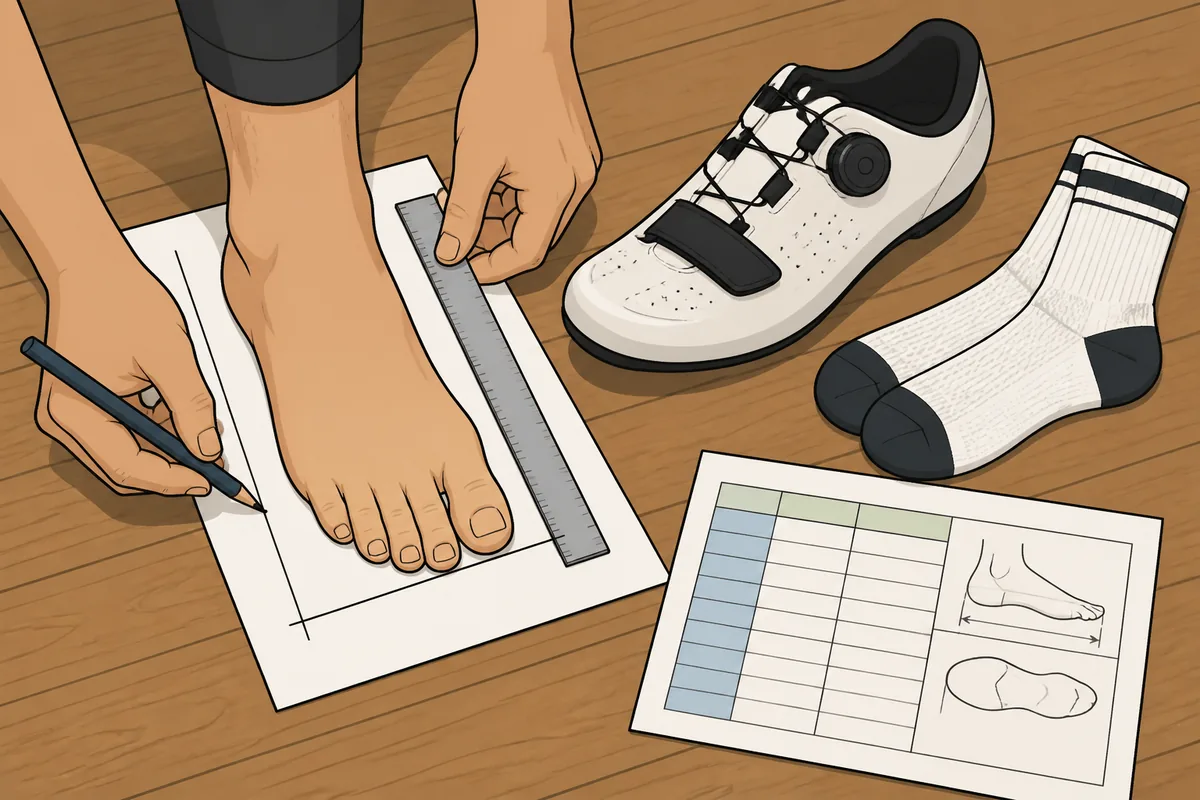
Choose the size that accommodates the larger foot. If one foot is several millimetres longer or wider, do not force both feet into a size chosen for the smaller one. A modest difference can sometimes be managed with sock choice or an insole adjustment, but the basic shoe still needs to fit the larger foot without excessive looseness on the other.
Cycling shoe size conversion: EU, UK and US explained
EU sizing is particularly common in cycling, but EU numbers are not perfectly standard between brands. UK sizing and US sizing use different scales, and US men’s, US women’s and unisex labels should not be treated as interchangeable. Confirm the sizing system before ordering, especially when buying internationally.
Half sizes are useful when your foot length falls between two published ranges or when a model’s shape is otherwise right. They fine-tune length; they rarely fix a fundamentally narrow shoe. If the little-toe joint or bunion area is being squeezed, a wide version or a different last is usually the correct answer.
Sizing up to gain width is a common but weak fix. It may create space at the sides, but it can leave the heel loose and the midfoot poorly supported. That movement reduces pedalling control and may create new pressure points. Try a wide-fit shoe, a roomier model or a different brand before accepting an oversized length.
A close race fit is not the default for every rider. Racers may prefer a precise, low-volume upper, while commuters, indoor cyclists and gravel riders often benefit from a little more toe comfort and volume. There is no prize for making your feet feel like they have been shrink-wrapped.
What a correctly fitted cycling shoe should feel like
A well-fitted shoe holds the heel securely without pinching it. The midfoot should feel supported, not crushed, and your toes should be able to move slightly. You should not feel concentrated pressure over the little-toe joint, bunion area or the top of the foot.
Check the fit standing and while clipped into the pedals. Your foot position and pressure change when you ride, so a shoe that feels fine in a shop can reveal a problem once the closure is tightened and the foot is working. You do not need a painful, rigid fit to pedal efficiently.
Closure systems change how easily you can manage pressure, but they cannot change the fundamental shape of the shoe:
- BOA dials allow small, convenient adjustments and can spread tension through the upper. They cannot create extra width if the shoe’s last is too narrow.
- Ratchets and straps provide firm retention and useful adjustment, although pressure can be concentrated if the upper does not suit your foot.
- Laces can distribute pressure smoothly across different foot shapes. They are less convenient to adjust during a ride and should be kept clear of the drivetrain.
Most beginners overbuy stiffness, carbon soles and race-oriented uppers. A stiff sole can reduce unwanted flex, but it does not rescue the wrong width or poor heel hold. Correct fit, comfortable pressure and a secure foot usually matter more than premium construction. Shimano RC or XC-style shoes, for example, still need to suit your foot shape; the category name does not do that job for you.
Cycling shoe fit problems and the usual fixes
| What you feel | What to check first |
|---|---|
| Toes touch the front | Check measured length, sock thickness and whether the larger foot needs the next size. |
| Numb or tingling toes | Loosen the closure, check width and account for foot swelling. Do not assume numbness is normal. |
| Heel lift | Check the closure and shoe volume. Sizing down may help only if your toes still have enough room. |
| Pressure at the sides | Try a wide fit or different last before sizing up. |
| Hot spots under the foot | Check sole shape, sock thickness and closure pressure. Cleat position can contribute after basic shoe fit is correct. |
| Foot movement inside the shoe | Check for excessive length or volume, then reassess the size and heel hold. |
Make one small change at a time. Reduce closure pressure first if your toes are numb, then check whether the shoe is narrow or your socks are too thick. If the heel lifts, tightening the shoe may help, but it should not require crushing the forefoot to keep the back of the foot in place.
Do not buy a new pedal system or expensive custom insole before the basic shoe length, width and closure pressure are right. Premium accessories cannot correct a shoe that is simply the wrong shape. Likewise, a half size is not a solution for every problem: it is mainly a length adjustment.
Persistent pain, burning, numbness or changes in foot colour deserve professional assessment rather than endless experiments with shoe sizes. Cycling shoes should feel secure and close, not painful.
For most riders, the best starting choice is the measured length of your larger foot checked against the manufacturer’s chart, in the width and shape that hold your heel without squeezing your forefoot. Stop upgrading when the shoe is stable, comfortable and free of pressure points. That fit will do more for your next ride than a stiffer sole or a more expensive closure.

I’ve spent way more time in the bike trade than anyone should reasonably want to. In that time I’ve wanted to make cycling jargon and marketing easier to cut through to help people get the bike of their dreams.
When I’m not writing about bikes, I can be seen out bikepacking on single speed bikes or teaching kids how to ride.