Convert cycling distance, ride time and average speed (mi/mph or km/km/h). Example: 40 km at 25 km/h → 1 hour 36 minutes. Planning tool only – not a prediction of your real-world finish time.
Cycling pace calculator
Use matching units: choose kilometres with km/h, or miles with mph. Enter positive values for the quantities being calculated. A blank, zero or negative speed cannot produce a useful result.
Cyclists normally talk about average speed, rather than running-style pace such as minutes per mile or minutes per kilometre. Average speed is usually the clearer number for bike rides, although the time result can be useful when planning an arrival.
How the cycling pace calculation works
The maths is simple. The useful part is choosing realistic inputs and keeping the units consistent.
| You want to calculate | Formula |
|---|---|
| Time | Distance / speed |
| Average speed | Distance / time |
| Distance | Speed x time |
For example, a 40 km ride at 25 km/h takes 40 / 25 = 1.6 hours. The whole number is 1 hour, and 0.6 of an hour is 36 minutes, so the result is 1 hour 36 minutes.
That conversion matters because 1 hour 30 minutes is 1.5 hours, not 1.30 hours. Decimal hours and clock notation are not interchangeable. Convert miles to kilometres, or minutes to decimal hours, before doing the calculation. The calculator also avoids pretending to know more than it does: a result such as 24.673 km/h suggests laboratory precision when your ride data includes wind, junctions and a coffee stop.
Moving time versus elapsed ride time
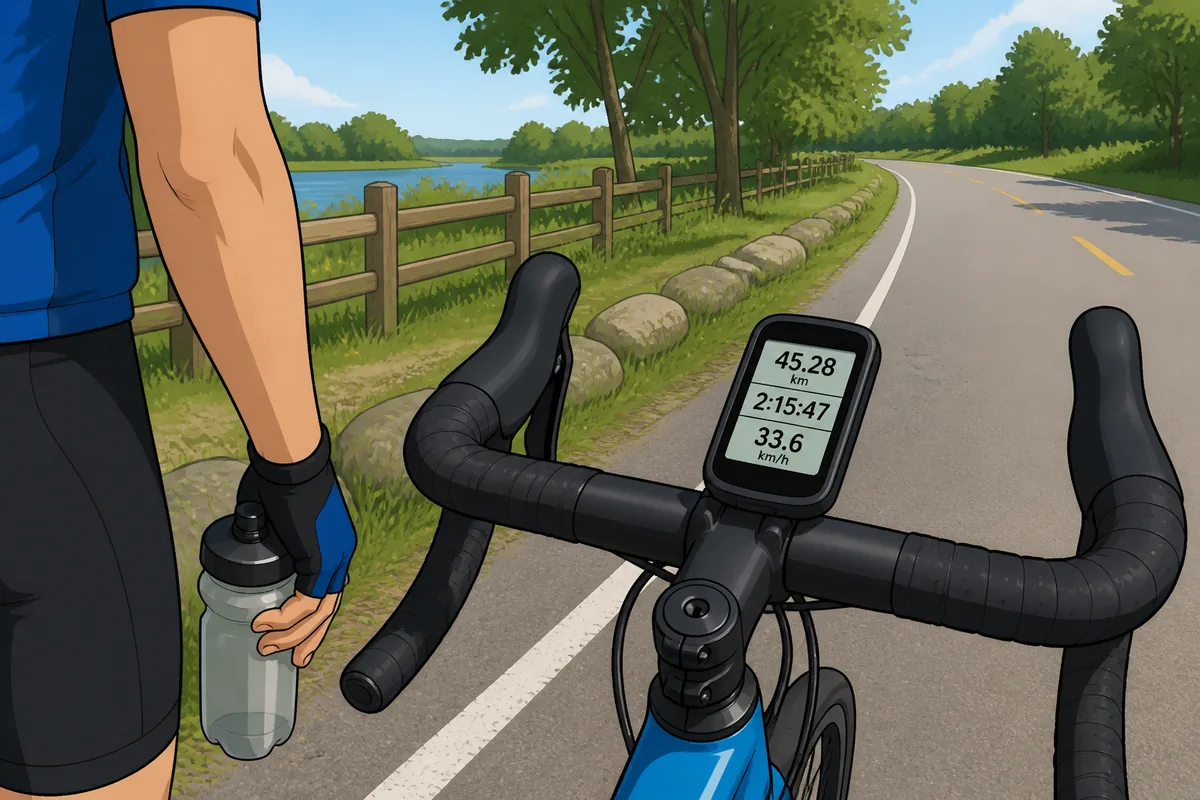
Moving time is the time you spend riding. Elapsed time is the full period from starting to finishing, including traffic lights, navigation stops, punctures, cafe breaks and conversations beside the bike.
A bike computer or GPS app may show either figure, or both. Event results can also use their own timing method, which is why two average speeds from the same ride may not match.
Use moving speed when comparing riding effort between similar rides. Use elapsed speed when working out when you will actually arrive. For arrival planning, elapsed time is the safer default because the road does not pause its clock while you stop for a snack.
If you ride 60 km in 2 hours 30 minutes of moving time but take 30 minutes of stops, your moving average is 60 / 2.5 = 24 km/h. Your elapsed average is 60 / 3 = 20 km/h. Both figures are correct, but they answer different questions. Do not compare a solo ride's elapsed average with a group's moving-time average as if they described the same performance.
What the calculator can and cannot predict
Use the calculator for route planning and rough targets, not as a promise that you will finish at exactly 3:42 pm. Its answer is only as good as the average speed you enter.
- climbing and descending;
- headwinds or strong crosswinds;
- rough road surfaces;
- junctions, traffic and crossings;
- temperature and fatigue;
- drafting in a group;
- luggage, clothing and food stops.
Average speed hides changes in pace. A quick descent can cancel out a slow climb in the final number without making the ride feel evenly paced. Beginners usually overestimate speed by using a best-case flat-road number and forgetting hills and stops. A realistic average from a similar route is more useful than an optimistic number from a short, sheltered ride.
Do not treat a disappointing estimate as proof that you need deeper wheels, an aero helmet or a new bike. Route conditions, pacing, tyre pressure and unnecessary stops are cheaper and more common variables to check first. For structured training, power, heart rate and perceived effort usually tell you more than average speed because they help account for wind, gradient and fatigue.
For broader context on typical riding speeds, see our guide to average road bike speed. This calculator has a narrower job: converting your own distance, time and speed inputs.
Using cycling pace for training and bike setup
A target speed can help you estimate the duration of an endurance ride, set an arrival window for a commute or check your margin against an event cut-off. The best use is repeatable comparison: use similar routes in similar conditions and watch how the result changes over time.
For training, compare a familiar route rather than chasing one impressive average. A slower day into a headwind may represent a perfectly good effort, while a fast group ride may say more about drafting than your solo pace.
Average speed is also a poor reason to upgrade a bike by itself. Before spending on faster wheels or expensive clothing, check that your computer is calibrated, your tyres are sensibly inflated, your route data is correct and your pacing is not producing long stops. A correctly set-up bike and reliable data usually beat a shiny solution to the wrong problem.
Cycling pace calculation examples
- Time for 10 miles at 15 mph: 10 / 15 = 0.6667 hours, or approximately 40 minutes.
- Average speed for 50 km in 2 hours: 50 / 2 = 25 km/h.
- Distance covered in 90 minutes at 20 km/h: 90 minutes = 1.5 hours; 20 x 1.5 = 30 km.
Pace per mile or kilometre is the reciprocal of cycling speed. At 15 mph, one mile takes 1 / 15 of an hour, or 4 minutes. Cyclists generally find average speed more convenient, but the conversion can help when comparing cycling with running or walking times.
For the most dependable estimate, enter a speed from a comparable route, decide whether you are using moving or elapsed time, and round the result sensibly. That gives you a practical arrival window rather than a number with more decimal places than certainty.

I’ve spent way more time in the bike trade than anyone should reasonably want to. In that time I’ve wanted to make cycling jargon and marketing easier to cut through to help people get the bike of their dreams.
When I’m not writing about bikes, I can be seen out bikepacking on single speed bikes or teaching kids how to ride.