What is a cyclocross bike?
Cyclocross bikes are drop-bar bikes built for short, muddy races: grass, sand, dirt, and the odd bit of pavement, with barriers you get off and run. The same wide tires and brakes also get used for commuting, winter road miles, and light gravel.
This page is the cyclocross bike guide. The bikes around $2,000 are first. The cheaper bikes that used to sit on their own under-$1,000 page are in Best cyclocross bikes under $1000 below. If you are still choosing between a race bike and a gravel bike, start with cyclocross vs gravel.
A novice does not need the most expensive race bike on the course. You need to know whether you are racing most weekends or trying the sport on a bike you can also commute. The two price bands below are that split.
Some terms to know
- Cyclocross is a cross between road racing and mountain biking. Riders race laps on mixed surfaces and get off to clear obstacles. Races last from about 30 minutes to an hour, often in winter.
- Tire and mud clearance is the space between the frame and the tire. If mud packs in there, the wheel stops.
- Disc brakes squeeze pads against a rotor. They still work when the rim is coated in mud. UCI cyclocross races limit tires to 33 mm, so a frame that clears only that width is a race frame. A frame that clears 40 mm or more is built for the rest of the year. Tire choice is its own problem: see the best cyclocross tires.
- Hydraulic disc uses fluid. It is the stronger, lower-maintenance option in the wet.
- Cable disc pulls a metal cable. It is cheaper, less powerful, and rusts if you ignore it.
- Finishing kit is the bar, stem, seatpost, saddle, and the other parts that are not the frame, wheels, or drivetrain.
- Tubulars are race tires glued to a rim. They are for a second wheelset, not for the bike you lock outside work.
What do you need?
If this bike is also your commuter, you want fender and rack mounts. A pure race bike often deletes them.
If you want a race bike and buy one with six bottle bosses but no mud clearance, you will be disappointed the first wet weekend.
A 1x drivetrain sheds mud better because there is no front derailleur to pack up. A 2x with a 46/30 crank is the better commuter gear range, and it is the one that clogs on a muddy course.
Best cyclocross bikes around $2000
Cannondale CAADX 1

The CAADX is still Cannondale’s alloy cyclocross bike. The current CAADX 1 uses a SmartForm C2 alloy frame, a full carbon fork, thru-axles, and Shimano GRX 400 hydraulic discs. Shifting is GRX 400 10-speed, with an FSA 46/30 crank and an 11-36 cassette. Stock tires are Schwalbe CX Comp 700×35, and Cannondale lists clearance up to 37 mm. Locally lists the MSRP at $1,875. Dealers have been listing it around $1,850.
That 46/30 front derailleur is the same compromise as before. It is a useful gear range for the road to work. On a muddy course it is the part that packs up. The current frame does have a removable fender bridge and hidden fork fender mounts, so the commuter case is better than the older bike that had no front fender mount.
The photo is an earlier CAADX. The button is the 2021 REI listing that went with that photo, not a promise that every size of the current bike is on that page.
Boardman CXR 8.9
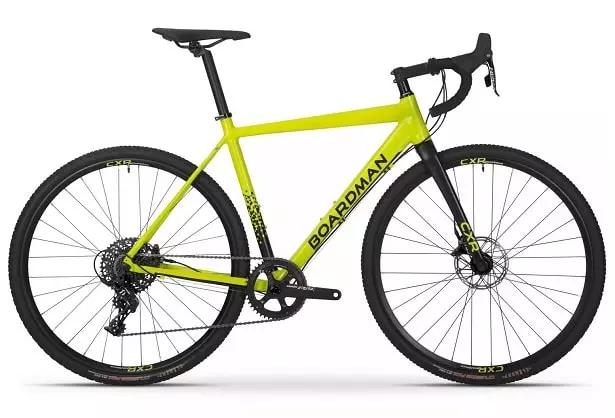
Boardman still sells the CXR 8.9, listed at £1,200. It is a 7005 alloy cyclocross frame with a full carbon fork, SRAM Apex 1×11 (44t chainring, 11-42 cassette), and SRAM Apex hydraulic discs with 160 mm rotors. Boardman lists the weight at about 11.0 kg. The spec sheet tires are Donnelly PDX 700×33. The rims are tubeless-ready. The stock tires are wire bead, so they are not the tubeless pair.
This is the race-shaped bike in the $2,000 conversation if you can buy it in the UK. Sizes run SM through XL, with recommended heights from 167 cm to 195 cm. There is no US shop button for it.
Trek Crockett 5 Disc

The name is Crockett, not Crocket. Trek’s product page for the Crockett 5 Disc now says it has no replacement. The build on that page is a 300 Series Alpha Aluminum frame, a carbon fork, SRAM Rival 1×11 with a 40t chainring and an 11-32 cassette, and SRAM Rival hydraulic discs. Trek lists a size 56 at 9.02 kg / 19.89 lb, a 275 lb total weight limit, and a max tire of 38 mm.
Shops were still listing leftover Crockett 5 Disc bikes in November 2026, around $1,700 to $1,900 against a $2,400 tag. That puts a leftover under this page’s $2,000 line. It is not a 2026 model Trek is building again.
The 1x and the race geometry are why it is here. It is a cyclocross bike you can also ride to work, not a rack-and-fender bike. The button still goes to Trek’s Crockett 5 Disc page.
Orange RX9 S

Orange still makes the RX9, and the brand now calls it a gravel bike. The current RX9 S is 6061 aluminum with a carbon-legged fork, Shimano GRX 400 10-speed, an FSA 44/30 crank, GRX hydraulic brakes, and Maxxis Receptor 700×40 tires. Sizes are S, M, L, and XL (47, 50, 53, 56 cm). Orange lists bottom-bracket height from the ground at 360 mm on a 700c tire. That is a gravel number, not a high cyclocross bottom bracket.
The old “cable discs and a lower group” description does not match this RX9 S. The 2023 product URL is gone. Four sizes are still the fit limit: if you are between two of them, a brand that sizes every 2 cm will fit more people. The photo is the earlier bike. The shop button is the Stork Grey in size M.
Specialized Crux E5

The Crux E5 in the photo was a race bike: SRAM 1×11, SRAM hydraulic discs, and a wheelset Specialized expected you to replace with tubulars. The frame used quick-release skewers. Specialized’s current Crux page does not list an E5. The alloy bike there now is the Crux DSW, next to a carbon Crux 5 range that is a different, much more expensive bike.
Treat this section as the bike in the photo, not as a model you can order new. The old shop button opened a Pros Closet search for “crux,” not this E5, so it is gone.
Cinelli Zydeco
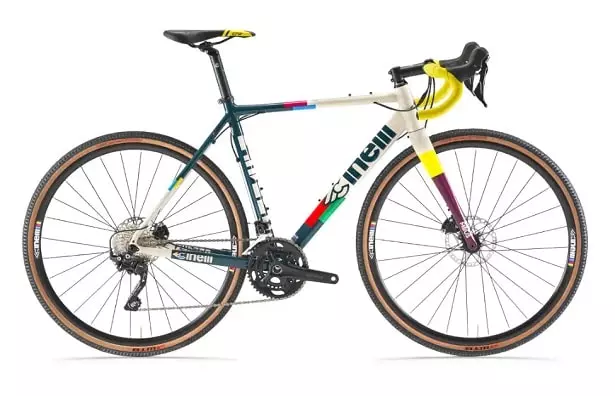
Cinelli still sells the Zydeco. The current collection is the aluminum gravel bike, and the Zydeco GRX Mix is listed at €1,990. The mechanical-disc, “buy it on Amazon” description belongs to the earlier bike in the photo, not to that GRX listing.
The frame idea has not changed. Columbus aluminum, internal cables, and a quicker geometry than a pure comfort gravel bike. It is the stylish one-bike option, not the lightest race bike above.
Best cyclocross bikes under $1000
Under $1,000 you are not buying a UCI race bike. You are buying a drop-bar bike with disc brakes, lower-than-road gearing, and enough room for a 33 mm cyclocross tire. Most of them are gravel bikes. That is the honest inventory at this price. When the season ends you can commute on the same bike, or keep it as a gravel bike under $1,000.
The Gravity Liberty CX, Pure Cycles Adventure Gravel Pro, and Raleigh Amelia 2 from the old list are not current bikes. The Vitus Energie was already hard to find in 2023. They are not picks below.
Salsa Journeyman Claris, now the Journeyer Claris 700
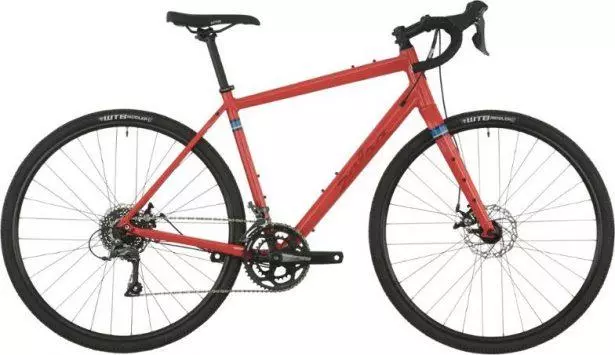
The photo is the Journeyman Claris 700, the bike this section was written around, at about $950 when that REI listing was the current one. Salsa’s current name is Journeyer. Salsa’s own page archives the 2022 Journeyer Claris 700, and US shops were still listing that build in November 2026 from about $550 to $999.
The archived spec is a 6061 aluminum frame, an aluminum fork, Shimano Claris 2×8 with a 46/30 crank and an 11-34 cassette, Tektro mechanical discs, 160 mm rotors, and Teravail Washburn 700×38 tires. The frame fits 700×50. The fork fits 700×56. It has rack and fender mounts. That is a first cyclocross bike and a commuter, not a bike you should shoulder through a muddy UCI race every Sunday.
The button is the older Journeyman REI listing, which is the bike in the photo.
Diamondback Haanjo 2

The Haanjo 2 is a gravel bike you can put a cyclocross tire on. REI’s later listing marks it discontinued, at $799.93 against a $1,000 comparison price. That listing is Claris 2×8, Tektro mechanical discs, WTB 700×37 tires, and rack and fender mounts. Diamondback’s own site is not selling a Haanjo 2 now. The Haanjo still on that site is the Haanjo 5, which is a different, much more expensive bike.
Buy it only if you find the leftover. The 46/34 gearing in the older write-up and the 2×8 on the REI listing are both low enough for a muddy field. Mechanical discs are the brake you get at this price. They are better than cantilevers in the wet, and they do not grind the rim.
The button is the 2021 Haanjo 2 listing that matches the photo.
Triban GRVL 120
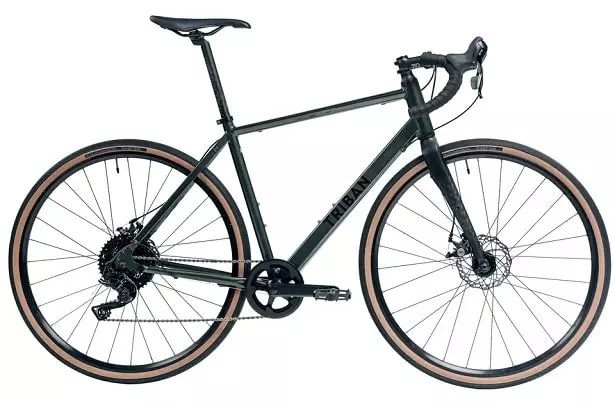
The GRVL 120 was the Decathlon bike in this price band: alloy frame, a fork with carbon blades, a 1x group, mechanical discs, and rack mounts. The old shop link now opens the Decathlon homepage, and the old UK product URL now opens a gravel category page. We are not calling it a current buy, and there is no button.
What you give up under $1,000
You give up hydraulic brakes, a lighter frame, and a 1x group that was designed for mud. You usually gain mounts, wider tire clearance, and a bike you will still ride in March.
Spending the extra money, up toward the CAADX, Crockett, or CXR 8.9, gets you that race equipment. It does not get you a better commuter. If you are not sure you will race, stay in this section. If you already know you will, the bikes above $1,000 are the ones with the groupset you will not replace next winter. A gravel bike under $3,000 is the other way to spend that money if the riding is long gravel rather than a one-hour race.
Final words
Pick the job first. A weekend race series wants the 1x hydraulic bikes around $2,000, or a leftover Crockett if you can find one. A first season, plus commuting, wants the Journeyer or a leftover Haanjo 2.
I once raced a singlespeed cyclocross bike just to see if I could finish not last. The bike was not the point. The point was knowing what I was asking it to do. Buying a race bike and then paying again for fenders, wider tires, and a lower gear is the expensive way to learn that.

My name is David Mckinven AKA Wheels of Karma. Bikes have been my life and have taken me to rural Africa as a bike mechanic teacher, Dubai as the SBC workshop manager and to work for as long as I care to remember.
I have written for Cyclist magazine and a host of online publications. I truly believe that bikes can save our planet and that small changes will make all the difference.